

Learner Driver Insurance in Spain: What the Law and Your Policy Require
Spain has no separate “learner policy” in the British sense. The car is insured, not the learner, and if you practise outside a driving school the insurer of that car must be told. The DGT (Dirección General de Tráfico, Spain’s traffic authority) asks for proof of that notification when you apply for the learning licence. Get this step wrong and the cover you thought you had can be a problem at the worst possible moment. As an English-speaking brokerage that compares quotes from over 11 Spanish insurers, we set out below how the system works and what to check before anyone takes the wheel.
TL;DR
- Learning to drive in Spain happens in an authorised driving school, or privately with a licencia de aprendizaje (learning licence), which is granted only once.
- The DGT requires proof that the vehicle’s insurer knows the car will be used for learning. Your existing policy is the starting point, not the end of the story.
- Compulsory third-party liability insurance is legally required for every car, and the owner answers alongside the driver if a car is uninsured.
- Named-driver and age conditions vary by insurer, so read your policy wording before the first lesson.
- Spain is preparing to allow accompanied driving from 17 under an EU directive, but the deadline for transposing it is 26 November 2028.
Table of Contents
- How learners are allowed to drive in Spain
- The learning licence in practice
- Does a learner need their own insurance?
- What to check before a learner drives your car
- What happens if conditions are not met
- Practising on a scooter or motorbike
- Accompanied driving from 17: what is coming
- Why use a bilingual broker for this
- Get your car cover compared in English
- FAQ
- Sources
How learners are allowed to drive in Spain
The rule comes from the Reglamento General de Conductores. Article 41 of Real Decreto 818/2009 says learning to drive takes place in authorised driving schools (autoescuelas). The only way to learn outside one is a learning licence, which can be granted once, provided you name the person who will accompany you and take charge of the dual controls.
That gives you two routes:
- A driving school. The school provides the car, the dual controls and a qualified teacher. Teachers need a recognised professional qualification and an authorisation to teach, under Real Decreto 1295/2003, and they are responsible for the dual controls and traffic safety during the lesson.
- Free learning with a learning licence. You practise in a private car with a named supervisor. This is the route where your own insurance comes into play.
Most expats we meet are already thinking about the second route when they ask this question: a teenager at home, a partner who has never driven in Spain, or an adult who wants to practise in the family car before the test. If that is you, the rest of this article is the part that matters.
The learning licence in practice
According to the DGT’s 2025 Manual V on learning-to-drive regulations, the licence:
- is only granted for learning to drive ordinary category B cars;
- is granted once only;
- is valid for a maximum of eight months, within which you must pass the practical test on open roads;
- requires you to pass the theory test first and to name the supervisor;
- is applied for at the Jefatura Provincial de Tráfico, the provincial traffic office.
The Spanish competition authority’s study of driver training adds the practical conditions around the supervisor and the car:
| Requirement | What it means |
|---|---|
| Supervisor | Holds a category B licence for more than five years and acts without payment |
| Vehicle ownership | In the name of the supervisor or the learner |
| Vehicle marking | Fitted with the learner plate, sealed by the provincial traffic office |
| Controls | Dual brake and clutch |
| Insurance | Proof that the insurer has been informed of the learning use |
The last row is the one people overlook. The first four are physical and visible. The fifth is paperwork, and it is the one that links the DGT’s rules to your insurance contract.
Does a learner need their own insurance?
Not in the sense of a policy in the learner’s name. Spanish motor insurance follows the vehicle: the plate, where it is kept and who is expected to drive it. The compulsory cover is a civil liability policy, and under Real Decreto Legislativo 8/2004 every owner of a motor vehicle normally kept in Spain must take out and maintain one for each vehicle, valid across the European Economic Area.
So the practical question is not “which learner policy do I buy?” but “does my current policy accept a learner at the wheel, and has the insurer been told?”
The DGT lists the documents you must carry: driving licence, vehicle registration document and technical data sheet, together with a valid insurance covering at least the compulsory liability. The Spanish consumer centre of the European network explains that the number plate serves as proof of liability insurance, though carrying the receipt and policy documents in the car is recommended.
What compulsory cover pays for
The compulsory policy covers damage to third parties: other drivers, passengers outside the car, pedestrians. For personal injury the legal limit is 70 million euros per incident, as set in article 4 of the same law. That protects the people your learner might hurt. It does not repair your own car after a learner’s mistake. For that you need own-damage cover, which is a policy choice. Our guide on third party versus comprehensive cover explains how that decision works for cars under five years old.
What to check before a learner drives your car
Before the supervisor and learner leave the driveway, go through this list. Each point can be answered by your policy schedule and conditions.
- Tell the insurer in writing. The DGT wants proof that the insurer has been informed of the learning use. Ask for written confirmation you can attach to the licence application, rather than relying on a phone call.
- Look for named-driver and age conditions. Many policies list who may drive, and some set minimum ages or minimum years with a licence. A learner without a licence at all is a different risk from a young driver with one. Our article on how to declare named drivers with the DGT and your insurer shows how the declaration works.
- Check the supervisor. They must hold a category B licence for over five years and not be paid. If your spouse passed their test recently, they do not qualify.
- Check the policy type. If you only have third-party cover, damage to your own car during practice is yours to pay for. Comprehensive cover is the one that responds to your own damage, subject to its conditions.
- Check any excess. Some policies apply a higher excess (the amount you pay on each claim) for younger or less experienced drivers.
- Keep the documents in the car. Licence, registration, technical data sheet and insurance receipt, plus the learning licence once issued.
If you are importing the car or driving a foreign-plated one, the position is more complicated, and the plates and registration status matter. Our page on UK-registered car insurance in Spain covers that situation.
What happens if conditions are not met
Two things can go wrong, and they are different.
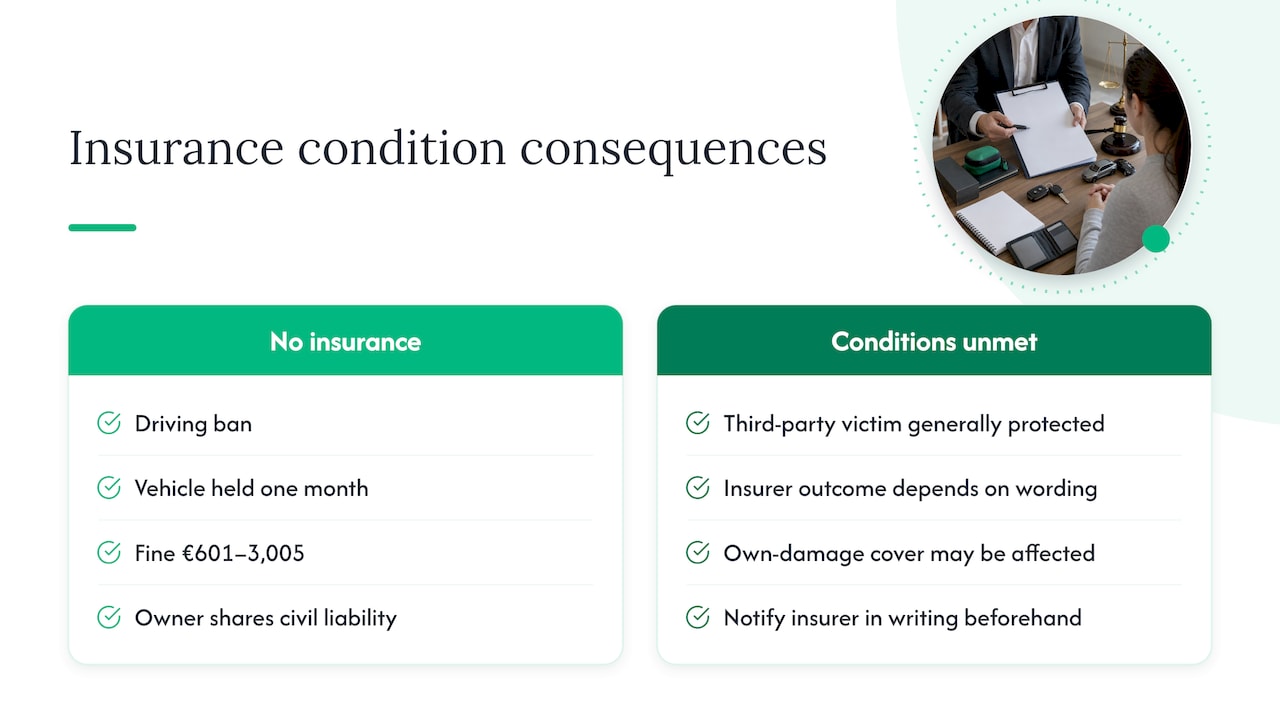
The car has no valid insurance at all. Article 3 of the liability and motor insurance law provides for a ban on driving, with the vehicle held or sealed for one month (three for a repeat, one year for breaking the seal), and a fine of 601 to 3,005 euros. The owner who was not driving is also civilly liable together with the driver for the damage caused. In other words, lending your car to a learner does not move the responsibility off you.
The car is insured, but the policy conditions are not met. This is the more common trap for families. The compulsory cover exists to protect third parties, so the victim of an accident is generally protected. What the policy conditions can affect is the relationship between you and your insurer, including who pays in the end and whether own-damage cover applies. We do not give a general answer on how a particular insurer will treat a particular claim, because it depends on the wording. That is exactly why the written notification matters: it puts the learning use on record before anything happens.
Practising on a scooter or motorbike
The learning licence is for category B cars only, so it does not apply to two-wheelers. A learner on a moped or motorbike works through different routes and different insurance questions. If this is what you need, see our pages on scooter and moped insurance, motorbike insurance and electric scooter insurance.
Accompanied driving from 17: what is coming
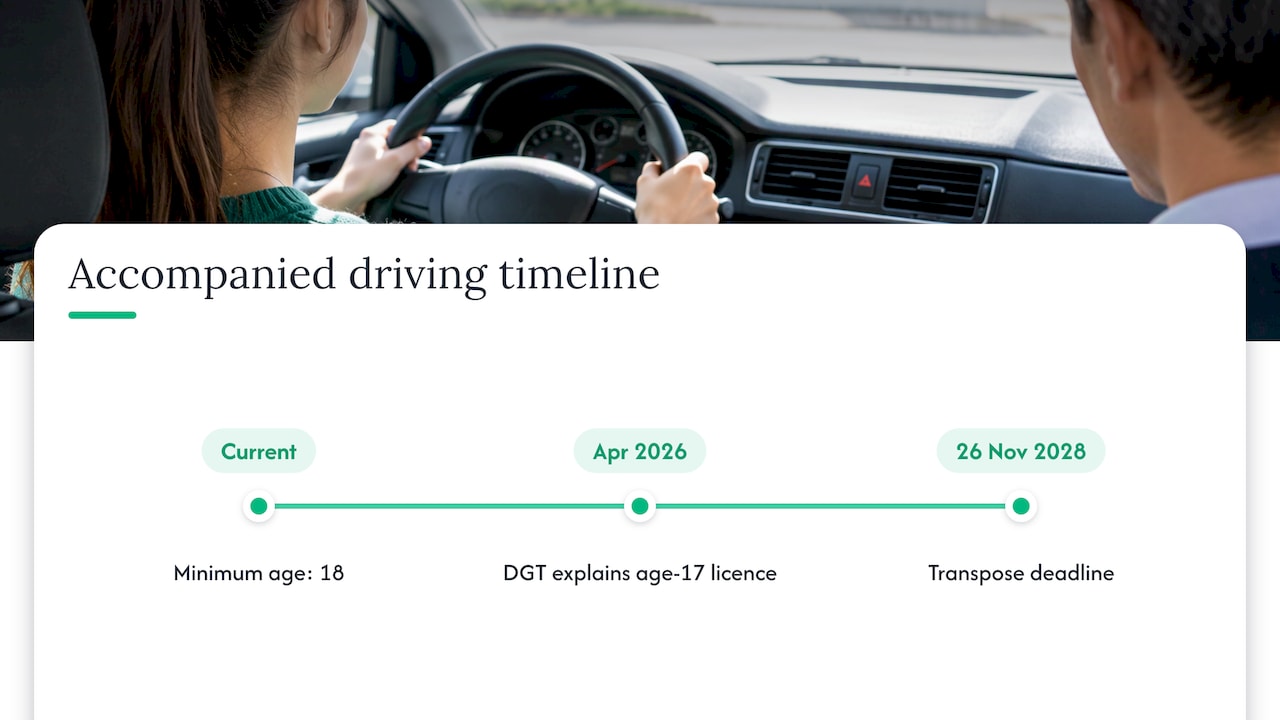
The current minimum age to drive in Spain is 18, according to the European Consumer Centre in Spain. A change is on the way. In April 2026 the DGT explained that Directive (EU) 2025/2205 lets 17-year-olds obtain a category B licence, marked with code 98.02, and drive only when accompanied until they turn 18. Spain has until 26 November 2028 to transpose it, and the DGT has set up a working group to amend the Reglamento General de Conductores.
Until the Spanish rules are actually amended, nothing changes for your policy. When they are, expect insurers to publish their own conditions for accompanied 17-year-olds. If you have a teenager approaching that age, it is worth reviewing the policy at renewal.
Why use a bilingual broker for this
The learner question sits between two Spanish systems: the DGT’s paperwork and the insurer’s contract. Each is written in Spanish, and each uses terms such as conductor habitual, conductor ocasional and póliza a todo riesgo that do not map neatly onto British ideas. Getting a clear written answer from an insurer is the part expats find hardest.
Because we are a brokerage and not an insurer, we compare quotes from over 11 leading Spanish insurers, including names such as Mapfre and Allianz, and our English-speaking team explains the options in plain language. Our service is free to you: we are paid a commission by the insurer when a policy is arranged, and there is no direct fee to the insured client.
Our view
The mistake we see most often in the expat community is treating the learner as the thing to insure. In Spain it is the car and its policy that count, and the question to put to the insurer is simple: “This car will be used for learning to drive, with a named supervisor. Please confirm in writing.”
We would rather you ask that question before the first lesson than after an incident. A written answer takes the guesswork out of the DGT application and out of your own planning. Because we compare across several insurers, you can see how different policies treat younger or newer drivers rather than accepting the first answer you hear.
Our advice is to settle the cover first, then the licence application, then the practice.
Jake
Get your car cover compared in English
If you are arranging a policy for a car that a learner will use, or reviewing the one you have, we can compare quotes across over 11 Spanish insurers and walk you through the conditions in English. For car cover in particular, see our page on car insurance in Spain for expats, or start from our home page.
If you are still setting up the car itself, our guides on registering a car and getting insured and on getting car insurance in Spain the same day cover the sequence.
FAQ
Can I teach my child to drive in my own car in Spain?
Only with a learning licence, granted once, and with a named supervisor who has held a category B licence for more than five years and is unpaid. The car needs dual controls and the learner plate, and the DGT expects proof that your insurer knows about the use. Otherwise lessons take place in an authorised driving school.
Do I need a separate learner driver policy in Spain?
Spanish insurance follows the car, so the usual route is to keep the car’s policy and inform the insurer of the learning use. Compulsory liability cover is required for every car. Whether your own damage is covered depends on whether you hold third-party or comprehensive cover.
How long does a learning licence last?
It is valid for a maximum of eight months, according to the DGT’s 2025 manual, and you must pass the practical test within that time. It can be granted only once, so plan your theory and practice before you apply.
Can a 17-year-old drive with a supervisor in Spain?
Not yet. The minimum age is 18. An EU directive allows accompanied driving from 17, and Spain has until 26 November 2028 to put it into its own rules. Check the DGT’s pages for the current position before relying on it.
What if my learner drives without valid insurance?
The vehicle can be taken off the road and held for a month, with a fine of 601 to 3,005 euros, and you as the owner are liable together with the driver for the damage caused. Make sure the policy is in force before any practice.
Sources
- Real Decreto 818/2009, Reglamento General de Conductores (BOE)
- Real Decreto 1295/2003 on driving schools (BOE)
- Real Decreto Legislativo 8/2004, liability and motor insurance (BOE)
- DGT Manual V, learning-to-drive regulations, 2025
- CNMC study on driver training services
- DGT: before driving in Spain
- DGT: accompanied driving from 17
- European Consumer Centre in Spain: driving in Spain