

Windstorm Insurance in the Canary Islands: What Your Home Policy Covers
In Spain there is usually no separate “windstorm policy”. Wind damage to a Canary Islands home is paid under the atmospheric phenomena (fenómenos atmosféricos) section of your home insurance, and only above the wind-speed threshold your policy sets. Beyond that, a state body called the Consorcio de Compensación de Seguros pays for truly extraordinary gusts. Knowing which of the two applies, and what your policy wording says, decides whether a storm claim is paid. We compare home policies from over 11 Spanish insurers for expats, in English, so you can see these wordings side by side before you sign.
TL;DR
- Wind damage is normally covered through the storm or atmospheric phenomena section of a Spanish home policy, not through a stand-alone windstorm product.
- The Consorcio covers wind damage only for extraordinary gusts above 120 km/h or tornadoes; ordinary storms are for your private insurer.
- A new policy generally needs to be in force at least seven calendar days before a natural event for extraordinary-risk cover to apply, so do not insure a house with a storm already forecast.
- Check the wind threshold, the sum insured for building and contents, the deductible and the exclusions for outbuildings, terraces and awnings before you renew.
- After damage, call your own insurer first. Your broker can help you with the claim.
Table of Contents
- Why wind is a real question in the Canaries
- How Spanish home policies treat wind
- Two layers of protection: your insurer and the Consorcio
- Worked example: a terrace, a window and the contents
- How to claim after a windstorm
- Reviewing your exposure across the islands
- Our point of view
- Compare home cover with an English-speaking team
- FAQ
- Sources
Why wind is a real question in the Canaries
The islands sit in the Atlantic, with exposed coasts, trade winds and, from time to time, Atlantic storms that bring strong gusts. Homes in the Canaries often have flat roofs with rooftop terraces, solariums, glazed balconies, pergolas, awnings and garden walls, and these are the elements wind tends to damage first. If you own a holiday home that stands empty for months, you also depend on a neighbour or manager to find the damage quickly.
The reader we have in mind is an expat living in Spain, a retiree with a second home, or an owner letting a property. Your questions are practical: will my policy pay if a gust takes the roof tiles, a window or the terrace awning, and who pays if it is something bigger?
How Spanish home policies treat wind
Spanish home policies do not usually list “wind” as a headline cover. Insurers include it in a storm or atmospheric phenomena clause, which typically groups wind, rain, hail and snow. The clause defines the event. A common approach is to set a minimum gust speed, and the policy may also accept evidence of damage to well-built properties nearby. The exact figure and the exact wording vary by insurer and by product, which is why you read the conditions and not only the summary page.
When a dispute arises over how strong the wind was, the evidence is meteorological. Spain’s state weather agency, AEMET, says on its insurance services page that it lists stations where maximum gusts or rain intensity exceed thresholds frequently used in insurance cover, and that it issues meteorological certificates from its records. For you, that means a gust claim can be backed by an official record for the nearest station, not only by your photographs.
Building and contents
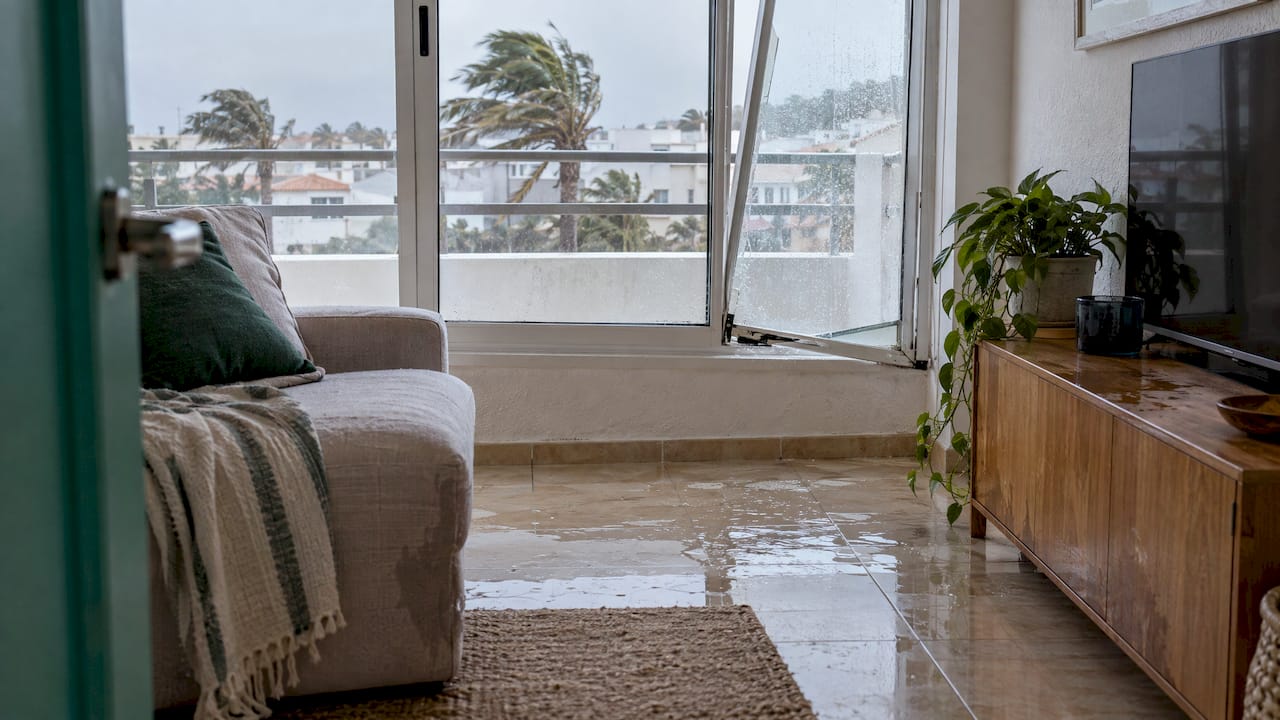
Spanish policies separate the building (continente: structure, roof, windows, fixed installations) from what is inside (contenido: furniture, appliances, belongings). Wind often damages the building first, and then rain enters through the opening and damages the contents. Check that you have both sections, and that each sum insured reflects the real rebuilding cost and the real value of your belongings. If the sum insured is too low, the proportional rule (regla proporcional) can reduce every payment in the same ratio, even for a small claim. It bites hardest after storms, when claims are many and loss adjusters check values closely.
What to look for in the conditions
We suggest reading five points in any policy before you decide:
- The wind threshold. What gust speed or evidence does the policy require for the event to count as a storm?
- The deductible (franquicia). Is there a fixed amount you pay on every claim, and does it apply to storm damage?
- Outdoor elements. Are terraces, awnings, pergolas, fences, garden walls, solar panels, aerials and swimming pool equipment covered, or excluded, or limited by a sub-limit?
- Water entering after wind damage. Does the policy pay for rainwater that gets in through an opening that the wind created?
- Maintenance and construction conditions. Insurers expect the building to be in reasonable repair. A loose roof tile or a corroded fixing that was already defective can make a claim harder.
A sub-limit is a cap on one item inside the policy, lower than the total sum insured. It is common for outdoor items, and you only see it in the full conditions.
Two layers of protection: your insurer and the Consorcio
The Consorcio de Compensación de Seguros is a Spanish state body that pays for extraordinary risks. These are paid from a surcharge that is already included in the premium of a home policy sold in Spain. It is not a replacement for your home policy. Its role is narrower.
When the Consorcio pays for wind
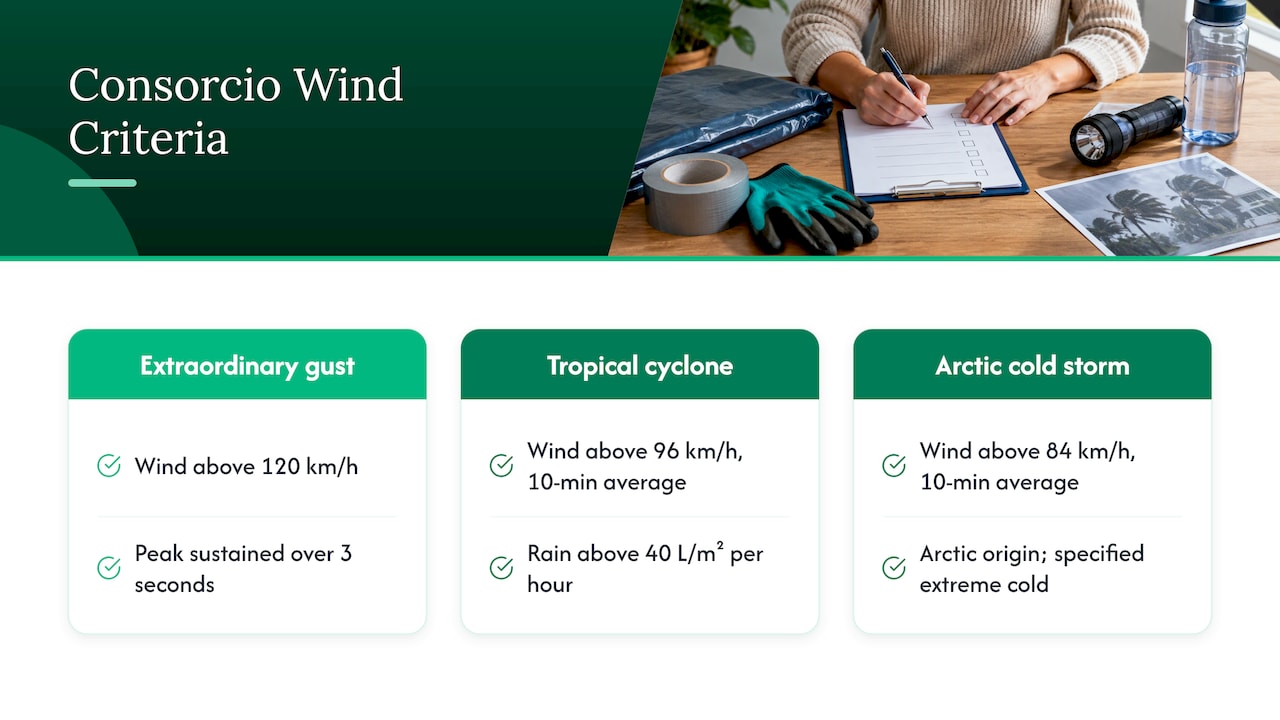
The official claims guide says the Consorcio covers wind damage only for extraordinary gusts above 120 km/h or for tornadoes. Ordinary wind damage is handled under the wind thresholds of your private policy. Royal Decree 300/2004 defines an extraordinary gust as above 120 km/h, a gust being the highest wind speed sustained over three seconds.
The same decree describes atypical cyclonic storms (tormentas ciclónicas atípicas) with different tests: certain tropical cyclones with winds above 96 km/h averaged over 10 minutes together with rainfall above 40 litres per square metre per hour, and certain intense cold storms of Arctic origin above 84 km/h averaged over 10 minutes under specified extreme cold. The Ministry of Consumer Affairs also makes clear that the Consorcio does not cover every instance of rain, wind or bad weather. It indemnifies the risks the law lists, such as extraordinary floods, earthquakes, tsunamis, volcanic eruptions and atypical cyclonic storms.
In practice, you do not need to work out which layer applies. You tell your insurer about the damage, and the insurer handles it.
What the Consorcio requires
According to the same guide, compensation requires that the person or property is insured under a policy with an authorised insurer, that the policy is in force at the time of the event, and that the premium is paid. A lapsed policy therefore leaves you without either layer.
The seven-day rule
Royal Decree 300/2004 generally excludes natural-event losses where the policy’s issue or effective date does not precede the event by at least seven calendar days. There are stated exceptions, such as uninterrupted replacement cover when you switch insurer. The lesson for a buyer of a Canary Islands property is to arrange the policy before completion day and to avoid a gap when you move from one insurer to another. If you are still collecting the documents needed to buy a home in Spain, put the insurance on the same checklist.
Worked example: a terrace, a window and the contents
Take an expat couple with a two-bedroom apartment on Tenerife’s south coast, with a covered terrace and an awning. A strong gust tears off the awning, breaks a sliding window and rain soaks the sofa and flooring.
- The awning. It is an outdoor element. Whether it is paid depends on whether the policy lists awnings and whether a sub-limit applies.
- The window. It is part of the building. If the gust meets the policy’s storm threshold, it is covered under the storm clause, less any deductible.
- The sofa and flooring. Contents damage from rain that came in through the broken opening is paid only if the policy includes water entering after wind damage.
- The threshold. If the gust was exceptional, above 120 km/h, the Consorcio’s cover can apply on top of your insurer’s, as described above.
The point of the example is not the figures but the order of questions. First the event, then the element, then the sum insured and the deductible.
How to claim after a windstorm
For wind or tornado claims, the Consorcio says you should contact your own insurer first. The insurer handles processing and payment, while the Consorcio and the meteorological authorities determine the affected municipalities. The insurer may later seek reimbursement from the Consorcio. The guide also allows a claim to be submitted by the insured, the policyholder, their representatives, the insurer, or the insurance agent or broker. Material damage claims to the Consorcio can be filed online or by calling 900 222 665.
A sensible routine:
- Protect the property. Secure openings with a temporary cover and stop water ingress. Keep the receipts, because reasonable emergency costs are usually part of a claim.
- Photograph everything before you move or throw anything away, and list damaged contents with approximate values.
- Report quickly. Spanish insurance law sets a seven-day period to notify a loss. The Consorcio itself accepts later requests, but a prompt report avoids discussions. Our guide to the first 24 hours of a home insurance claim covers the practical steps for expats.
- Keep the evidence of the weather. A certificate from AEMET records may support the wind speed at the nearest station.
- Follow the loss adjuster’s visit and keep your policy documents, inventory and repair quotes together.
If you live abroad for part of the year, name someone local who can open the door for the loss adjuster and tell them in writing who may act for you.
Reviewing your exposure across the islands
The official rules recognise that measurement is imperfect. The regulation tells the Consorcio to provide non-AEMET measurements for AEMET to contrast, and to seek AEMET’s help in setting the geographical area, with reasonable consideration of adjoining municipalities. For you, this means a gust recorded in a neighbouring municipality may matter to your case.
When you review cover, look at your own house rather than the island average:
- Exposure. A top-floor flat with a solarium, a house on a headland or a villa with a large pergola faces more wind than a flat in a sheltered street.
- Condition. Roofs, window frames, shutters and fixings that are well maintained are your best protection and also support any claim.
- Island and community. Apartment buildings share a roof and façade, so the building’s community policy matters. See our page on community insurance in Spain. If you are on Fuerteventura, our page on insurance in Fuerteventura is a good start.
- Other perils. Fire is a separate question for rural properties; see wildfire damage and Spanish home insurance.
Our point of view
Most of the storm-claim problems we hear about from expats are not about the weather. They come from a sum insured set too low, an outdoor element nobody checked, or a policy taken out days before a storm. All three can be seen in the paperwork before anything goes wrong.
That is why we put policies from different insurers next to each other and read the storm clause, the deductible and the outdoor sub-limits with you, in English. Our service costs you nothing, and we are paid a commission by the insurer when you sign a policy, so you can ask us as many questions as you need before deciding.
Our advice is simple: choose the home policy whose wording you understand, keep the building and contents sums realistic, and keep your insurance continuous when you renew or move from one insurer to another.
Jake
Compare home cover with an English-speaking team
Insurance Spain is a bilingual brokerage that compares home insurance from over 11 leading Spanish insurers, such as Mapfre and Allianz, for expats and foreign property owners. You get the comparison and advice without a fee and without jargon, so the storm clause, deductible and outdoor items are explained in plain English before you commit. Start on the Insurance Spain home page and tell us about your property in the Canary Islands.

If you are also arranging cover for a holiday let or a business, our business and liability cover pages show what we can arrange.
FAQ
Does my Spanish home insurance cover wind damage?
Usually yes, through the storm or atmospheric phenomena section, but only if the event meets the policy’s wind threshold and the damaged element is covered. Read the conditions for the threshold, the deductible and exclusions for outdoor items.
Does the Consorcio pay for every storm in the Canary Islands?
No. For wind, it covers extraordinary gusts above 120 km/h or tornadoes. Ordinary storm damage is dealt with under your private policy. Either way, you start by contacting your own insurer.
How long must a policy be in force before a storm?
For extraordinary-risk cover, the general rule in Royal Decree 300/2004 is seven calendar days between the policy’s effective date and the event, with exceptions such as uninterrupted replacement cover. Arrange the policy before you need it.
Can a broker file a windstorm claim for me?
Yes. The Consorcio’s guide allows an insurance agent or broker to submit a claim, in addition to the insured, the policyholder, their representatives and the insurer. We can help you gather the documents and follow the claim with your insurer.
Sources
- AEMET: insurance services
- Royal Decree 300/2004, BOE
- Consorcio de Compensación de Seguros: claims guide
- Ministry of Consumer Affairs: what the Consorcio covers