
The legal minimum, compulsory civil liability, costs the same whether you ride a 50cc scooter or a 1000cc motorcycle. What differs sharply is the real world cover you need above that minimum, and the premium you pay for it. Engine size, vehicle value, where you park, and how you use the bike decide almost everything else. Insurancespain compares policies from over 11 Spanish insurers so expats can see those differences side by side before choosing.
TL;DR:
- Third-party coverage is legally required and sufficient for low-value scooters, but higher tiers are advisable for valuable or frequently stolen bikes.
- Insurers typically scale premiums by vehicle value, engine size, driver age, and parking conditions, with secure garaging lowering theft risk and costs.
- Theft claims dominate scooter insurance issues, especially in cities, making theft prevention devices and accurate garaging declarations critical for affordable coverage.
- Premium costs differ sharply: around €250 annually for scooters, €400 for urban motorcycles, and up to €700 for sport bikes, driven primarily by engine size and usage.
- Expats should use bilingual brokers to navigate Spanish insurance jargon, ensure proper policy registration, and compare quotes from over 11 insurers efficiently.
Spanish insurers structure cover in three broad tiers, and the right one for you depends far more on the vehicle’s value and how exposed it is to theft than on whether it technically has two wheels or a scooter’s step-through frame.
Third-party (seguro a terceros) is the legal floor. It pays for damage or injury you cause to others, but nothing for your own vehicle if it’s stolen, burnt out, or written off in an accident that’s your fault. For an old commuter scooter worth a few hundred euros, this is often genuinely sufficient. There’s little point paying extra to insure a bike that costs less to replace than a year’s comprehensive premium.
Third-party plus (terceros ampliado) adds theft and fire cover on top of the legal minimum. This tier is where most scooter owners in Spain actually sit, because scooters are stolen at disproportionately high rates in cities where they’re left on the street rather than garaged. It’s a sensible middle ground for a mid-value 125cc scooter used daily.
All-risk (todo riesgo) covers your own vehicle’s damage regardless of fault, usually with an excess. Insurers commonly scale these tiers by vehicle value and theft exposure, which is why new or high-value motorcycles tend to justify the extra premium far more than an ageing scooter does.
Beyond the tier itself, several add-ons matter more for motorcycles than scooters:
Watch for exclusions that catch riders out: riding under the influence, an unauthorised or unlicensed rider using the bike, and unapproved modifications (an exhaust swap, a tuned engine) can all void a claim outright. Many insurers also sell simplified, cheaper packages specifically for 50cc ciclomotores, reflecting their lower risk profile and value. If you’re weighing up a moped or 125cc scooter policy against a full motorcycle policy, the vehicle’s value and how it’s parked should drive the decision more than the badge on the tank.
Scooters are almost always cheaper to insure, and the gap can be substantial. Illustrative industry figures put an adult’s scooter policy at around €250 a year, an average urban motorcycle around €400, and a young rider’s sportive motorcycle as high as €700, according to Motopoliza’s 2026 pricing guide. Those figures are indicative rather than fixed quotes, but the pattern holds consistently across Spanish insurers.
What actually drives the price:
No-claims bonuses (bonus by years without a claim) reduce premiums year on year, and most Spanish insurers recognise a no-claims record carried over from another EU country, though not always automatically. Raising your voluntary excess (franquicia) lowers the annual premium in exchange for paying more out of pocket if you do claim, a trade worth considering on an older scooter you’d happily replace rather than repair.
Pro Tip: If your scooter or motorcycle spends every night in a private garage rather than on the street, tell your insurer explicitly. Garaging can meaningfully cut theft-related premium costs, but only if it’s declared and recorded on the policy.
Compulsory civil liability insurance is a legal requirement for every motorcycle and ciclomotor on Spanish roads, no exceptions. Ride without it and you risk fines between €600 and €3,000, with vehicle immobilisation in serious cases. That penalty applies identically whether you’re on a 50cc scooter or a 900cc tourer.
Three things to keep in order:
You no longer need to carry paper copies of any of these. The miDGT app displays your driving licence, vehicle data, ITV status and insurance digitally, and traffic agents are required to accept it, under DGT instruction 20/V-145, as legally equivalent to the physical documents. A screenshot doesn’t count; it has to be shown live, in the app, connected to the DGT’s records. This matters because if your insurer hasn’t correctly registered your policy in that system, showing the app won’t help you, even if you genuinely paid your premium.
Helmet rules carry their own penalties, separate from insurance. Homologated helmets meeting the ECE 22.06 standard are mandatory, and riding without one can bring a fine of around €500 and the loss of four points from your licence.
Start by being honest about how you actually use the bike, because that single answer narrows your options faster than comparing premiums ever will.
If you commute daily in a city on a scooter you leave on the street, third-party plus theft and fire cover is usually the sensible baseline. If you ride occasionally, on weekends or short trips, a lower-mileage policy with third-party plus can cost noticeably less than a standard annual policy. If you own a newer or higher-value motorcycle, all-risk cover with a manageable excess protects an asset that’s expensive to replace outright.
Before signing anything, ask the insurer or your broker these questions directly:
Switching insurer or adding a second vehicle to an existing policy in Spain typically requires your NIE or DNI, current driving licence, the vehicle’s registration document (permiso de circulación), and an estimate of annual mileage. Most brokers can turn a quote around within a day once they have those.
Pro Tip: Check exactly how your policy records where the bike sleeps at night. A policy that lists “garaged” when the bike actually lives on the street isn’t just inaccurate, it can void your theft cover entirely if you ever need to claim.
The claims process itself follows the same basic steps for both vehicle types: report the incident, provide the police report if relevant, submit photos and the other party’s details, and wait for the insurer’s assessor. Where scooters and motorcycles diverge is in what typically triggers the claim and how it’s assessed.
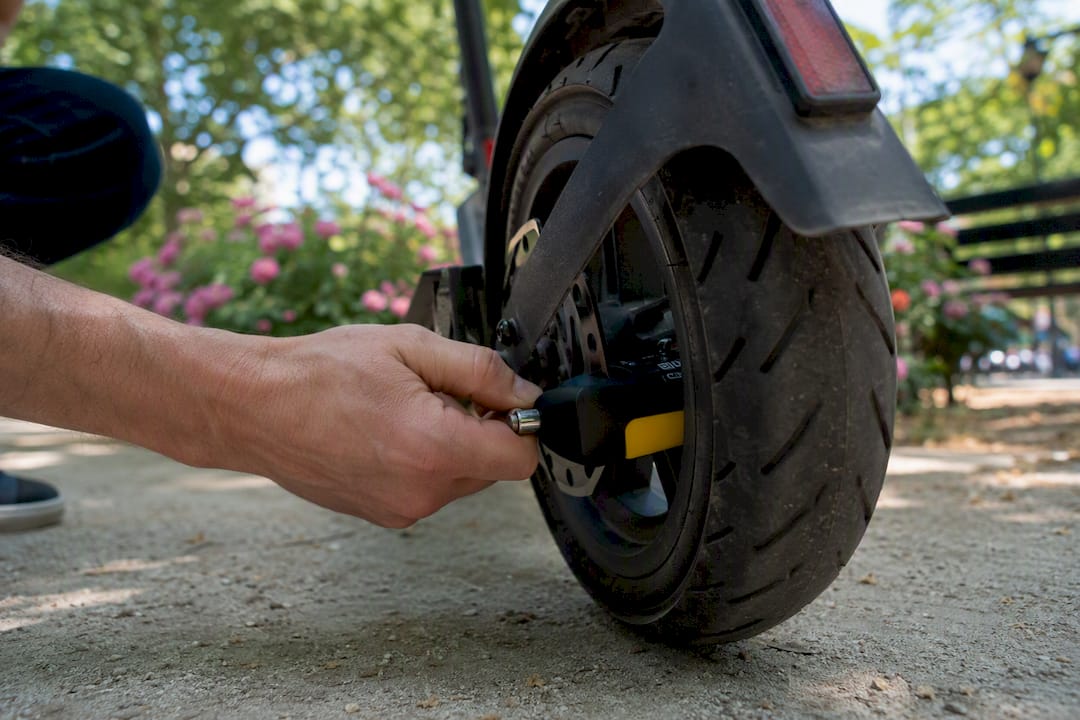
Scooter claims in Spain skew heavily towards theft, given how often they’re left unlocked or lightly secured on city streets overnight. That means insurers often ask for proof of the security device fitted, plus the exact parking location logged on the policy, before paying out. A mismatch between where you said you’d park it and where it was actually stolen from can delay or reduce the payout.
Motorcycle claims lean more towards collision and own-damage, particularly for machines used on faster roads or longer routes. Assessors on motorcycle claims tend to scrutinise the parts and labour cost more closely, since motorcycle components, especially fairings, exhausts and electronics, are frequently pricier to replace than scooter equivalents.
One practical difference worth knowing: if you carry legal defence cover, having it matters more after a motorcycle collision, where injury claims and third-party disputes are statistically more likely to escalate into something requiring a lawyer. For a scooter theft claim, the priority is usually just getting documentation together quickly, the police report (denuncia), the security device receipt, and proof of ownership, since most theft claims are relatively straightforward once those pieces are in place.
Insurers don’t set prices on gut feeling. They price against the accident and claims data their own books generate for each vehicle category, which is precisely why motorcycles above a certain engine size consistently cost more to insure than scooters of equivalent age and condition.
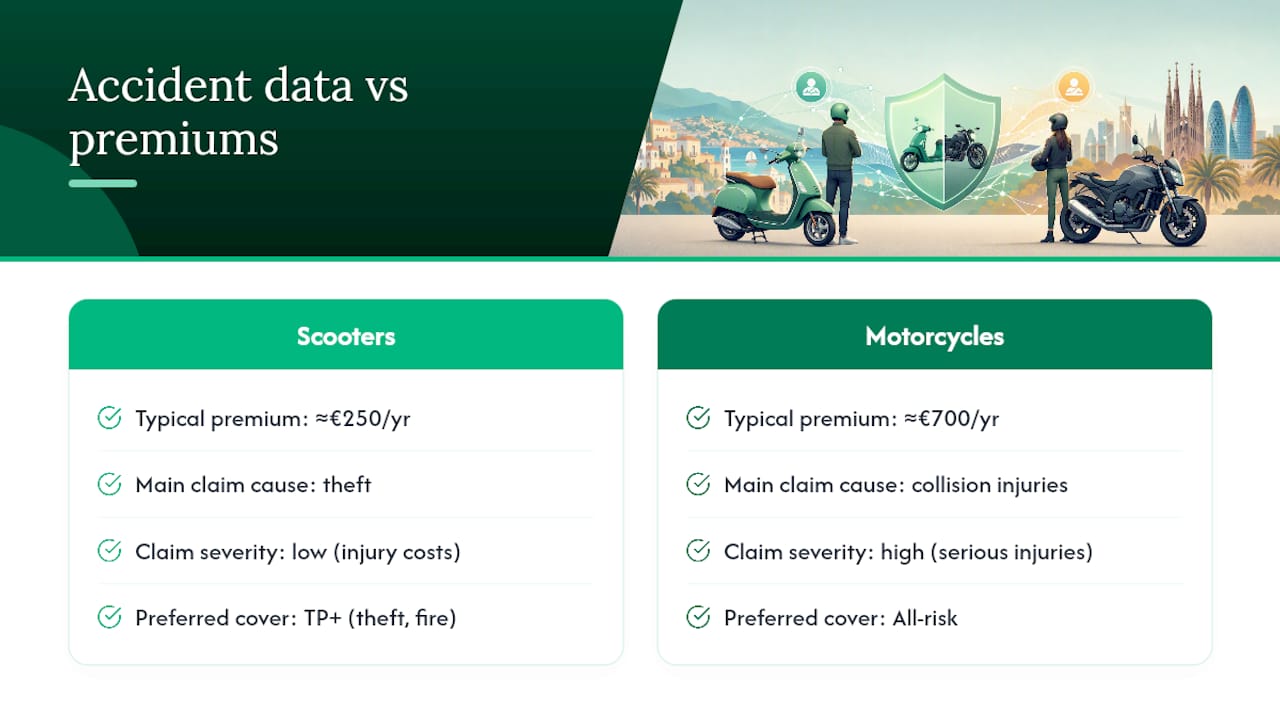
Higher-powered motorcycles are involved in a higher rate of serious injury claims per policy than 50cc or 125cc scooters, largely a function of speed differential in collisions. That risk profile shows up directly in the premium: a young rider on a sportive motorcycle can pay close to €700 a year compared with roughly €250 for an adult scooter rider on an equivalent policy tier, reflecting the gap in claim severity insurers price for, not just claim frequency.
Scooters generate their own distinct claims pattern, dominated by theft rather than injury severity. That’s part of why third-party plus, which adds theft and fire cover, is the tier most scooter owners actually need, while motorcycle riders are more often pushed towards all-risk to cover the higher cost of collision damage. Region plays into this too. Insurers factor in local theft rates and accident density, which is one reason premiums for the same bike can vary between a dense city centre and a quieter rural area of Andalusia or the Canary Islands.
None of this is fixed for life. A clean few years without a claim moves you down the risk curve regardless of what vehicle category you started in, and that no-claims progression is often the single biggest lever you control over time.
Both scooter and motorcycle policies in Spain offer a similar menu of discounts, though which ones actually move the needle differs by vehicle type. The no-claims bonus is the most powerful lever for both. Several consecutive years without a claim can meaningfully reduce your renewal premium, and most insurers apply it automatically at renewal rather than requiring you to ask.
Security-based discounts tend to matter more for scooters, given how often theft drives claims. Fitting a disc lock, chain, alarm, or GPS tracker can lower the theft-related portion of your premium, and some insurers ask for proof of the device before applying the discount. Garaging overnight, rather than leaving the bike on the street, is treated the same way.
Motorcycle riders more often benefit from mileage-based discounts, since a bike used occasionally at weekends carries less exposure than one ridden daily on the motorway. Declaring an accurate, lower annual mileage can bring the premium down noticeably, though insurers will expect that estimate to be realistic rather than optimistic.
Bundling policies with the same insurer, home and vehicle cover together, for example, can also unlock a discount, and several mainstream Spanish insurers now offer dedicated ECO products for electric and hybrid scooters, reflecting both lower environmental risk pricing and growing demand for electric scooter cover. If you’re considering an e-scooter, it’s worth checking these products specifically rather than assuming a standard petrol-scooter policy applies unchanged.
The pain points are predictable: policy wording in dense Spanish insurance jargon, uncertainty over what garaging declarations actually mean for a claim, and the stress of getting documents correctly registered with the DGT rather than just paid for. One mistranslated exclusion clause can cost you an entire claim.
Insurancespain compares policies across more than 11 Spanish insurers and provides English-speaking support throughout, including tailored guidance for 125cc scooter and moped cover specifically. Brokers who work daily with expats catch the details a rushed, translated read-through misses, and help ensure the policy is actually registered correctly with the insurer in Spain’s systems, not just purchased.
— Jake
Comparing a handful of insurers yourself is possible, but it eats an afternoon and still leaves you guessing at exclusions written in your second language. Insurancespain does that comparison for you, checking quotes from over 11 Spanish insurers side by side and explaining the wording in plain English before you commit to anything.

To get a quote moving, have your NIE or DNI, current driving licence, the vehicle’s registration document, and a rough annual mileage estimate ready. That’s usually enough for a broker to return comparable quotes within a day. Whether you’re insuring a 125cc scooter for the daily commute or a larger touring motorcycle, it’s worth comparing quotes and reading the policy wording, garaging clauses and excess in particular, before binding cover. Start a comparison at Insurancespain and get the right policy without wrestling with Spanish insurance small print on your own.
Be the first to leave a comment.
