

4 Steps Expats Take After Selling in Spain to Cancel Car Insurance
Once you have sold your car, tell your insurer in writing and attach proof of the sale — the signed contrato de compraventa or your DGT transfer receipt. Do this promptly, because most policies renew automatically unless you give notice, and you remain liable for premiums until the insurer confirms cancellation. Notify the DGT too, so you are never blamed for fines the new owner racks up.
TL;DR:
- Providing proof of sale, such as a signed contract and DGT transfer receipt, is essential for insurers to process your cancellation properly.
- You must notify the insurer in writing and ask for written confirmation of the cancellation, including the effective date, to avoid paying on a vehicle you no longer own.
- Filing the sale with the DGT online or in person is crucial, as it prevents future fines or taxes from being linked to the vehicle after the sale.
- If the insurer changed terms improperly or you sell the car outside the legal notice period, you may still cancel under specific conditions, such as proof of sale or contract violations.
- For a smooth cancellation, sending official proof via burofax or registered mail is recommended; relying solely on a phone call or direct debit cancellation can lead to disputes.
Table of Contents
- How to cancel car insurance after selling a vehicle
- Legal timing and notice rules in Spain
- What proof of sale your insurer actually needs
- Sending the cancellation notice the right way
- What happens to your premium and any refund
- If you missed the deadline or the insurer pushes back
- Why notifying the DGT matters as much as cancelling the policy
- What we see go wrong most often
- Get help cancelling or replacing your car insurance
- Sources
How to cancel car insurance after selling a vehicle
The moment the sale is done, you have four practical jobs to finish before the policy is truly closed. Miss one and you risk paying for cover on a car you no longer own.
- Gather your paperwork first. You need the signed contrato de compraventa, your DGT transfer or notificación de venta receipt, your policy number, and your ID. Insurers and the DGT both expect these before they will act.
- Send a formal cancellation notice. Write to the insurer requesting cancellation, attach the sale documents, and state the date you want cover to end. Ask explicitly for written confirmation and a stated effective cancellation date, not just an acknowledgement of receipt.
- Notify the DGT separately. File the notificación de venta online or at a DGT office and keep the receipt. This same document doubles as your strongest proof of the sale date when dealing with the insurer.
- Check your payment method afterwards. Once cancellation is confirmed, watch your bank account for a few weeks. Direct debits sometimes keep running even after an insurer has logged the cancellation internally, so a quick check saves an awkward refund chase later.
Pro Tip: Send the DGT receipt and the cancellation letter together. Insurers move faster when the effective date is backed by an official document rather than your word alone, and disputes about “when exactly” the risk disappeared become almost impossible.
Legal timing and notice rules in Spain
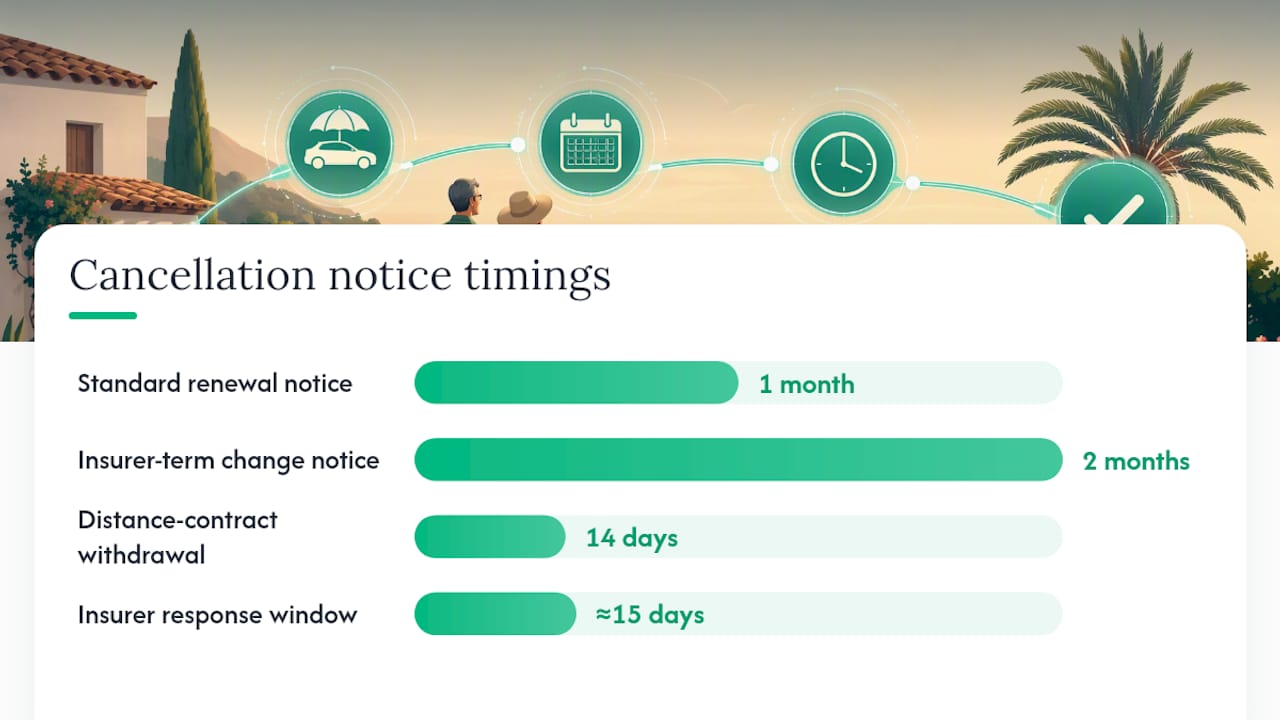
Spanish insurance law, under Ley 50/1980, works on prórroga tácita, automatic renewal. Since January 2016, you generally need to give at least one month’s written notice before your renewal date, or the policy simply rolls over for another year, premium and all.
Selling the car changes that picture. Three situations let you step outside the standard notice window:
- The insured asset no longer exists. Selling the car removes the insurable interest, so insurers commonly accept cancellation at any point once you provide valid proof of sale.
- The insurer changed your contract without proper warning. If they failed to give you two months’ notice of a change to terms or premium, you can cancel even mid-term.
- Distance contracts carry a 14-day withdrawal right. If you bought the policy remotely, that cooling-off period gives you a separate cancellation route entirely.
Once you submit valid proof, the insurer typically has around 15 days to confirm or reject the cancellation and act on any refund due.
What proof of sale your insurer actually needs
Insurers will not simply take your word that the car changed hands. They want documents that stand up, and so does the DGT if fines or taxes are ever questioned later.
- Signed contrato de compraventa. Both parties’ names, ID numbers, the vehicle’s registration and chassis number, and the sale date must appear clearly.
- DGT transfer paperwork or notificación de venta receipt. This is the single strongest piece of evidence you can hand an insurer or the authorities, since it carries an official timestamp.
- Supporting items worth keeping to hand. Your permiso de circulación, the ficha técnica, proof that road tax was paid up to the sale, and any bank receipt showing the payment changed hands.
Without at least the first two, your insurer can treat the policy as still active and renew it as normal.
Sending the cancellation notice the right way
A phone call feels quicker, but it leaves you with nothing to point to if the insurer “forgets” to process it. So does simply cancelling your direct debit, which insurers do not treat as a valid termination and can leave you owing unpaid premium plus fees.
- Burofax. The gold standard in Spain: legally timestamped, delivery certified, and hard for an insurer to dispute.
- Certified post with acknowledgement of receipt. Slower than a burofax but still gives you dated proof the letter arrived.
- Certified or registered email. A practical middle ground if the insurer accepts digital correspondence, provided it generates a delivery record.
Whichever channel you pick, the letter itself must state your policy number, the vehicle registration, the sale date, a clear request to cancel, and a list of the documents attached.
What happens to your premium and any refund
If your insurer accepts the cancellation, you are usually owed the unused portion of your premium from the effective cancellation date onward, minus any administration fee the policy allows. That refund normally follows once the insurer has processed your 15-day confirmation window, not before.
If a refund gets refused or delayed:
- Keep every dated document: the burofax receipt, the DGT paperwork, and any written reply from the insurer.
- Raise a formal complaint through the insurer’s own complaints department first.
- Escalate to the Dirección General de Seguros y Fondos de Pensiones (DGSFP) if the insurer stalls beyond a reasonable timeframe.
If you missed the deadline or the insurer pushes back
Missing the one-month notice window is not the end of the world, but it does narrow your options.
- Check whether a legal exception applies. Selling the car is itself grounds for cancellation outside the normal window, so the sale usually overrides a missed deadline.
- Check if the insurer changed your terms without proper notice. If they altered your premium or coverage without giving you the required two months’ warning, you can cancel regardless of timing.
- Escalate in writing if they disagree. Submit a formal complaint referencing your sale documents, and involve the DGSFP if the insurer refuses a cancellation you are legally entitled to.
Barring one of those exceptions, you will typically wait for the next renewal date before the policy can lapse cleanly.
Why notifying the DGT matters as much as cancelling the policy
Cancelling your insurance protects your wallet. Notifying the DGT protects your record. The notificación de venta is filed online or in person, requires your ID and the vehicle’s documents, and carries a small fee, reported at around €8.67 in recent press coverage.
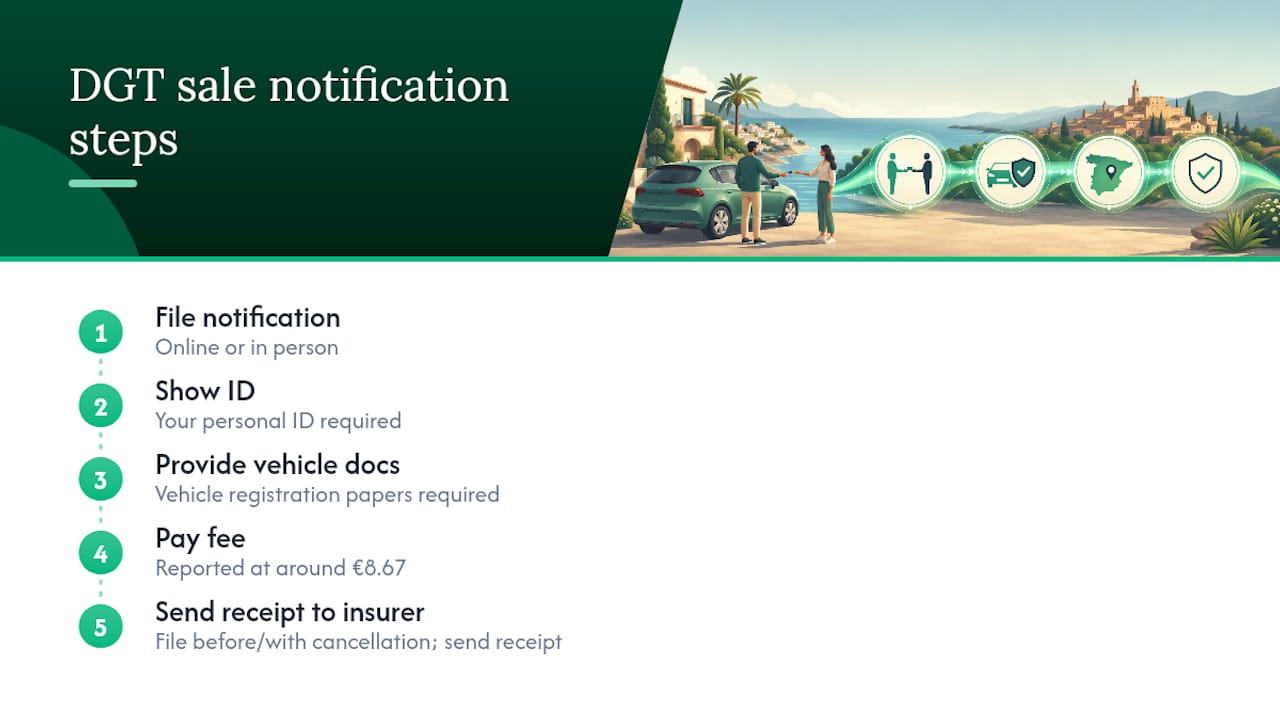
Skip it, and you stay the registered owner in the DGT’s eyes. That means fines, unpaid tolls, and even ITV notices linked to a car you no longer drive can land back on your desk months later.
Pro Tip: File the DGT notification before or alongside your insurance cancellation letter, then send the receipt to your insurer. One document fixes the sale date for both parties at once.
What we see go wrong most often
Sellers assume the sale itself ends the policy, or trust the buyer to “sort out the paperwork”. Neither works. As our guide to car insurance for expats explains, the contract stays live until you formally cancel it, and stopping your direct debit only invites a collections letter.
The safest route stays simple: written notice plus your DGT receipt, sent together. If the paperwork or the Spanish feels like a hurdle, a bilingual broker can handle the whole exchange with the insurer on your behalf.
— Jake
Get help cancelling or replacing your car insurance
Insurancespain is the practical alternative to wrestling with Spanish insurer paperwork alone. Rather than chasing a call centre in a language that is not your first, our bilingual team compares over 11 leading Spanish insurers, handles the cancellation correspondence, and lines up replacement cover if you are buying another car.

If you are still driving and simply switching providers, we can also help you find better terms before your current policy renews. Getting started is straightforward: send us your sale documents, tell us what you need next, and we take the cancellation and comparison work off your hands. Visit Insurancespain to request bilingual support and a free comparison across Spain’s leading insurers today.
Sources
- Dar de baja el seguro del coche: cómo hacerlo, plazos y qué no debes olvidar para no pagar de más
- Vender un vehículo de segunda mano — DGT
- Selling your car in Spain? Here’s how to tell the DGT and avoid getting someone else’s fines
- What your insurance covers in Spain — and how to cancel
Recommended
Key Takeaways
- ✓ Spanish policies renew automatically under prórroga tácita, and since January 2016 you generally need at least one month's written notice before the renewal date.
- ✓ The DGT notificación de venta receipt is the single strongest piece of evidence you can hand an insurer, because it carries an official timestamp.
- ✓ Cancelling the direct debit is not a valid termination and can leave you owing unpaid premium plus fees.
- ✓ File the DGT notification before or alongside your cancellation letter, then send the receipt to your insurer, so one document fixes the sale date for both.
Frequently Asked Questions
Quick answers on insurance in spain
Still have questions?
Contact us0 Comments
Be the first to leave a comment.


