

Put Medical Cover First: Annual vs Single Trip Cover for Spain Expats
If you take three or more short trips a year, annual multi‑trip cover is usually cheaper and simpler. If you’re planning one long or expensive holiday, buy single‑trip instead. Whichever you choose, the deciding factor for Spain-based travellers should always be medical and repatriation limits, not price. Check the trip-length cap, the aggregate limit, and whether the policy requires you to start and end your journey in Spain before you sign anything.
TL;DR:
- Check whether an annual policy’s trip duration cap exceeds your planned trips, as staying beyond 70 days can void coverage for the entire trip.
- Confirm if your policy’s annual aggregate limits are used up early in the year, reducing coverage for later trips within the same policy period.
- Ensure the start and finish points of your trips are in Spain, as some policies void coverage if journeys don’t originate and end there.
- Prioritize medical and repatriation limits over price, since these are most critical if a medical emergency occurs abroad.
- Use a detailed comparison service to verify policy clauses and limits suitable for your actual travel pattern, especially for medical coverage.
Table of Contents
- Annual vs single trip travel insurance: how the two policies actually differ
- What limits and clauses should you check before buying?
- How do you decide which policy suits your travel pattern?
- How do you compare costs and quotes fairly?
- What should you double-check before you sign?
- How does Insurance Spain help you choose between the two?
- Where expats usually get caught out
- Compare annual and single-trip policies before you commit
- Sources
Annual vs single trip travel insurance: how the two policies actually differ
An annual multi‑trip policy covers every eligible journey you take within a 12‑month period, up to a set number of days per trip. A single‑trip policy covers one journey, from the day you leave to the day you return, with limits set specifically for that trip.
Both typically include emergency medical treatment, repatriation, baggage cover, and cancellation protection, but the balance between them differs sharply. Annual policies are generally built around frequent travel and medical risk, so cancellation and baggage limits are often lower or capped as optional extras. Single‑trip plans, by contrast, typically allow stronger cancellation cover and higher per-trip limits, because the insurer is pricing one known trip rather than an unpredictable year of travel.
Add-ons vary by policy type too:
- Winter sports cover is often available on both, but usually costs extra on single‑trip policies and may be bundled cheaply into annual plans if you ski regularly.
- Adventure or high-risk activities (diving, trekking above altitude limits) usually need separate declaration on either policy.
- Cancel For Any Reason (CFAR) cover, which lets you cancel for a reason not otherwise listed, is more commonly available on single-trip policies than on annual ones.
Some industry guides note that annual plans lean heavily towards medical protection at the expense of generous cancellation cover, which matters if you regularly book non-refundable flights or accommodation.
What limits and clauses should you check before buying?
The small print on annual policies causes more disputes than the headline price ever does. Three clauses matter more than the rest.
- Per-trip duration cap. Annual policies typically cap each individual trip at somewhere between 31 and 70 days, depending on the insurer. Stay one day beyond that cap and you may have no cover at all for the remainder, or for the whole trip.
- Aggregate versus per-trip limits. Many annual plans set aggregate yearly limits for cancellation and certain other benefits, rather than resetting the full limit for every trip. A large early-year claim can shrink what’s left for a trip in October.
- Start/end-in-Spain clauses. Several annual products void cover if a trip doesn’t originate and terminate in the policyholder’s country of residence. That catches expats who, for example, fly from Spain to visit family in the UK and then on to a third country before returning, rather than flying home first.
Pro Tip: Ask your broker directly whether your policy’s limits reset per trip or aggregate across the year. It’s the single question that most affects your real-world cover, and it rarely appears clearly on comparison sites.
How do you decide which policy suits your travel pattern?
A rough break-even rule works well as a starting point: if you expect two to three or more short trips a year, an annual policy usually costs less overall than buying single‑trip cover each time. That guidance shifts depending on destination, trip length, and how much medical cover you need, so treat it as a starting point rather than a rule.
Three common scenarios illustrate this well:
- One long-haul holiday a year, three weeks in Southeast Asia. Buy single‑trip cover. You’ll get higher medical and cancellation limits matched to that specific journey.
- Four or five weekend trips around Europe. Annual multi‑trip is almost always cheaper and removes the hassle of buying a new policy each time.
- A mix of short breaks plus one expensive, non-refundable trip. Consider a hybrid: annual cover for the frequent short trips, with a single-trip top-up for the big one, so the expensive booking gets its own dedicated limits.
How do you compare costs and quotes fairly?
Comparing an annual premium against several single-trip premiums only works if you prorate properly. Divide the annual price by the number of trips you realistically expect to take, then compare that per-trip figure against what a single-trip policy would charge for the same journey with matching limits.
Age and any pre-existing medical conditions change this calculation. Premiums rise with age on both policy types, and insurers can decline or reprice cover once a condition is undisclosed at the time you take out the policy. This can shift the break-even point in either direction, so run the comparison with your actual health profile, not a generic quote. For Spain-based travellers, medical treatment abroad and repatriation back to Spain should carry the highest priority limits of anything on the policy, well ahead of baggage or cancellation cover.
What should you double-check before you sign?
Run through this before committing to either policy type:
- Declare every pre-existing condition at purchase, and check whether the policy requires you to redeclare before each departure.
- Confirm the maximum days allowed per trip and whether the policy requires you to start and end your journey in Spain.
- Check which geographic zone you’ve selected. Comparison sites show that Europe-only, worldwide-excluding-USA, and full worldwide bands materially change price and eligibility, and some policies exclude the USA and Canada entirely under the mid-tier option.
- Confirm whether winter sports or adventure activities need separate declaration or an add-on.
- Note the aggregate limit for the policy year, any upper age cap, and the insurer’s direct claims and emergency assistance contact details.
Pro Tip: Save the insurer’s 24-hour emergency assistance number somewhere other than your phone, such as a card in your wallet. If your phone is lost or stolen abroad, that number is the one detail you can’t easily replace.
Our guide on travel insurance for residents in Spain covers how medical and repatriation limits interact with Spanish healthcare access in more detail.
How does Insurance Spain help you choose between the two?
Working out whether annual or single-trip cover suits your travel pattern is straightforward in principle, but the clauses that decide real claims sit deep in policy wording most people never read closely. Insurance Spain compares policies from more than 11 leading insurers in the Spanish market, in English, so you’re checking exact wording rather than guessing at a translated summary.
The service typically helps with:
- Checking per-trip duration caps and aggregate yearly limits against your actual travel pattern.
- Confirming whether a policy’s start/end-in-Spain clause fits how you actually travel.
- Comparing medical and repatriation limits across insurers, since these matter most for Spain-based expats.
- Flagging pre-existing condition disclosure requirements before you commit.
Because the comparison happens across multiple insurers at once, it usually saves time and removes ambiguity from policy wording that’s easy to misread under a language barrier. Our piece on avoiding costly gaps in expat travel cover goes further into disclosure pitfalls specifically.
Where expats usually get caught out
The same two mistakes come up again and again. One is straightforward: someone books an annual policy, then takes a six-week trip that exceeds the per-trip cap buried in the policy document, and only discovers it when a claim gets rejected. The other is quieter but more serious: a traveller doesn’t disclose a manageable pre-existing condition at renewal, assuming last year’s declaration still applies, and finds the insurer treats every departure as a fresh disclosure point.
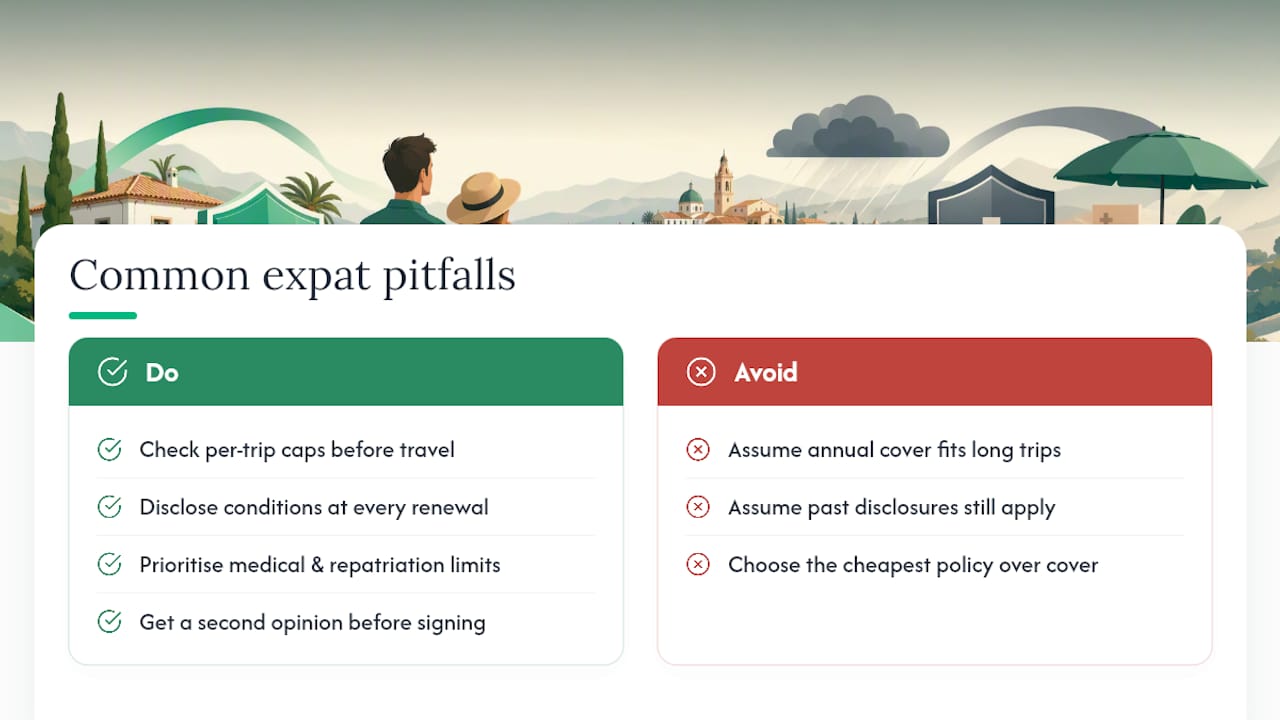
Neither mistake is really about carelessness. It’s about policy wording that’s written for insurers, not for the person buying the cover. For anyone living in Spain, medical and repatriation limits should always come before price or convenience when you’re weighing these decisions, because a cheap policy with thin medical cover is no bargain the day you actually need it.
If anything in this guide feels unclear once you’re looking at your own renewal notice, it’s worth getting a second opinion before you sign rather than after you’ve claimed.
— Jake
Compare annual and single-trip policies before you commit
Working through trip-length caps, aggregate limits, and start/end-in-Spain clauses on your own is doable, but it’s slow, and the wording differs from one insurer to the next. Insurance Spain compares travel policies from 11+ leading Spanish insurers in English, checking the specific clauses covered in this guide against your actual travel pattern rather than a generic quote.

That comparison covers trip-length limits, aggregate versus per-trip caps, geographic zones, and add-ons like winter sports or CFAR, so you’re not choosing blind between two policy types that look similar on paper but behave very differently at claim time. If medical cover is your main concern while living in Spain, our private health insurance page explains how travel medical limits interact with your ongoing healthcare arrangements. To get a free, no-obligation comparison of both annual and single-trip options tailored to how often and how far you travel, compare travel insurance quotes with Insurance Spain today.
Sources
- Annual vs. single trip travel insurance (Comparethemarket)
- Annual travel insurance: compare plans & prices (Squaremouth)
- Single trip vs multi‑trip travel insurance: when to buy (NerdWallet)
- Should I get annual or single trip travel insurance? (MoneySuperMarket)
Recommended
Key Takeaways
- ✓ Three or more short trips a year usually makes annual multi-trip cover cheaper and simpler; one long or expensive holiday is better served by single-trip.
- ✓ Annual policies typically cap each trip at 31 to 70 days, and exceeding the cap can leave you with no cover for the trip.
- ✓ Aggregate yearly limits mean an early large claim can reduce what remains for later trips in the same policy year.
- ✓ Check the geographic zone you have selected, since Europe-only, worldwide-excluding-USA and full worldwide bands materially change price and eligibility.
Frequently Asked Questions
Quick answers on insurance in spain
Still have questions?
Contact us0 Comments
Be the first to leave a comment.

