

8% Insurance Premium Tax in Spain: What Expats and Small Businesses Must Check
Spain charges Insurance Premium Tax at a standard rate of 8% on most non-life policies, and your insurer, not you, carries the legal duty to calculate, collect and remit it. Before you sign anything, check that your quote shows the all-in price with tax included and confirm whether your cover qualifies for an exemption, because life and health policies often escape the charge entirely.
TL;DR:
- Only motor, home, and liability policies are generally taxable, while life insurance and health policies are typically exempt from the 8% IPT charge.
- Insurers calculate the tax on the premium before statutory add-ons and must show separate lines for the surcharge and fire brigade charge on premiums.
- Correct postcode and risk location information are essential to avoid misallocation and incorrect IPT filings, especially in regions with special tax regimes like Navarra or the Basque territories.
- Compliance relies heavily on timely submission of Form 430 monthly and Form 480 yearly, with penalties mainly affecting administrative accuracy rather than the tax rate itself.
- Using a bilingual comparison service like Insurancespain can simplify obtaining an all-in, IPT-compliant quote and ensure proper reporting across multiple providers.
Table of Contents
- What is IPT in Spain and which policies it affects
- How IPT is calculated and presented on premiums
- Filing and compliance: forms 430 and 480
- Regional rules, Consorcio reporting and the CLEA surcharge
- Practical tips for expats and small businesses
- How Insurance Spain helps with IPT compliance
- Three quick actions if something looks off
- Get an IPT-compliant quote without the paperwork headache
- Where to check the rules yourself
- Sources
What is IPT in Spain and which policies it affects
The Impuesto sobre Primas de Seguros is an indirect tax charged on the premium itself, not on any profit the insurer makes. It functions similarly to VAT in that it is baked into the price you pay, but it runs on entirely separate rules and a separate declaration process. The standard rate sits at 8%, unchanged since January 2021, and it applies within Spanish territory to any insurer writing risk here, including certain branches of insurers based elsewhere in the EEA.
Not every policy attracts the charge. Common exemptions and taxable categories include:
- Exempt: life insurance, private health insurance, reinsurance, group pension schemes, and risks in international transit.
- Taxable: motor insurance, home and buildings cover, general liability, and most commercial property policies.
- Grey area: accident cover bundled inside an otherwise exempt policy, which is usually taxable on that component alone.
If you are weighing up a life insurance policy in Spain, the exemption is one of the clearer financial advantages over a taxable savings product, since you avoid the 8% loading entirely.
How IPT is calculated and presented on premiums
The tax base is the total premium payable for taxable cover, before certain statutory add ons. Two items, the extraordinary risks surcharge collected for the Consorcio de Compensación de Seguros and the fire brigade charge some municipalities levy separately, are excluded from that base and should appear as distinct lines on any proper breakdown.
A worked example makes this concrete. Say your home insurance carries a net premium of €400.
- Net premium: €400.00
- IPT at 8%: €32.00
- Extraordinary risks surcharge (excluded from IPT base): added separately
- Final payable amount: €432.00 plus the surcharge
The tax adds a fixed 8% on top of the net premium on almost every motor, home and liability policy sold in Spain, which is why the gap between the “headline” price quoted verbally and the figure that hits your bank account can catch people out.
Mixed policies need particular care. Where a contract blends an exempt element, such as a life wrapper, with a taxable one like accidental death cover, only the taxable portion should carry the 8% charge, and your invoice ought to show that split clearly.
Filing and compliance: forms 430 and 480
Insurers, not policyholders, are the taxpayers of record. They calculate IPT at the point of collection and carry the reporting burden through two returns filed with the Agencia Tributaria:
- Form 430 is the monthly declaration, reporting premiums collected and tax due for that period.
- Form 480 is the annual summary, reconciling the year’s monthly filings into a single return.
- EEA insurers writing risk in Spain without a local branch typically need a fiscal representative to handle these filings on their behalf.
- Brokers and insurers should keep clean records tying each policy to its postcode, premium base, and applicable exemption, since this is what a tax inspection will ask for first.
For a business running several policy lines at once, the practical risk is not the rate itself but the paperwork discipline behind it. Missing a Form 430 deadline is far more common than miscalculating the 8%, and it is the kind of administrative slip a good broker exists to prevent.
Regional rules, Consorcio reporting and the CLEA surcharge
Spain’s tax map is not entirely flat. The Basque historical territories (Bizkaia, Gipuzkoa, Álava) and Navarra operate their own foral tax regimes, which means IPT declarations for risks located there can follow a different administrative route than the rest of the country.
- Postcode, or “location of risk,” is a compulsory field in Consorcio de Compensación de Seguros reporting, and it determines which provincial authority a policy is allocated to.
- Insurers submit Consorcio data monthly alongside their standard IPT filings, and a wrong postcode can misroute a policy to the wrong regime entirely.
- CLEA, a small surcharge funding the wind up activity of failed insurers, typically runs at around 0.15% of relevant premiums and sits alongside IPT rather than replacing it.
Industry specialists note that this patchwork of provincial regimes, foral exceptions and Consorcio requirements is exactly why IPT compliance in Spain carries more operational weight than the flat 8% rate suggests on paper.
Practical tips for expats and small businesses
Most IPT problems that reach an ombudsman or a broker’s inbox trace back to one of three things: an unclear quote, a wrong postcode, or an unexplained direct-debit change.
- Ask for a full breakdown showing net premium, IPT, and any surcharges separately, not a single bundled figure.
- Confirm the postcode on your policy matches your actual address, especially if you have moved within Spain recently, since a mismatch can misallocate the risk between provincial authorities.
- Keep a copy of your original contract and premium schedule, so you have something to compare against if your bank debit changes unexpectedly.
- If a debit differs significantly from what you authorised, Banco de España guidance allows you to query and potentially reclaim it within eight weeks of the payment date.
Pro Tip: Always compare the figure on your quote to the figure your bank actually debits before you assume the two match. A discrepancy between a verbally quoted premium and the direct-debit instruction is one of the most common complaints Banco de España handles for insurance clients, and it is far easier to fix in month one than after a year of silent overcharging.
If you are dealing with a non-Spanish insurer, it is worth asking your broker directly whether that insurer holds a fiscal representative in Spain, since this affects who is accountable if a filing goes wrong.
How Insurance Spain helps with IPT compliance
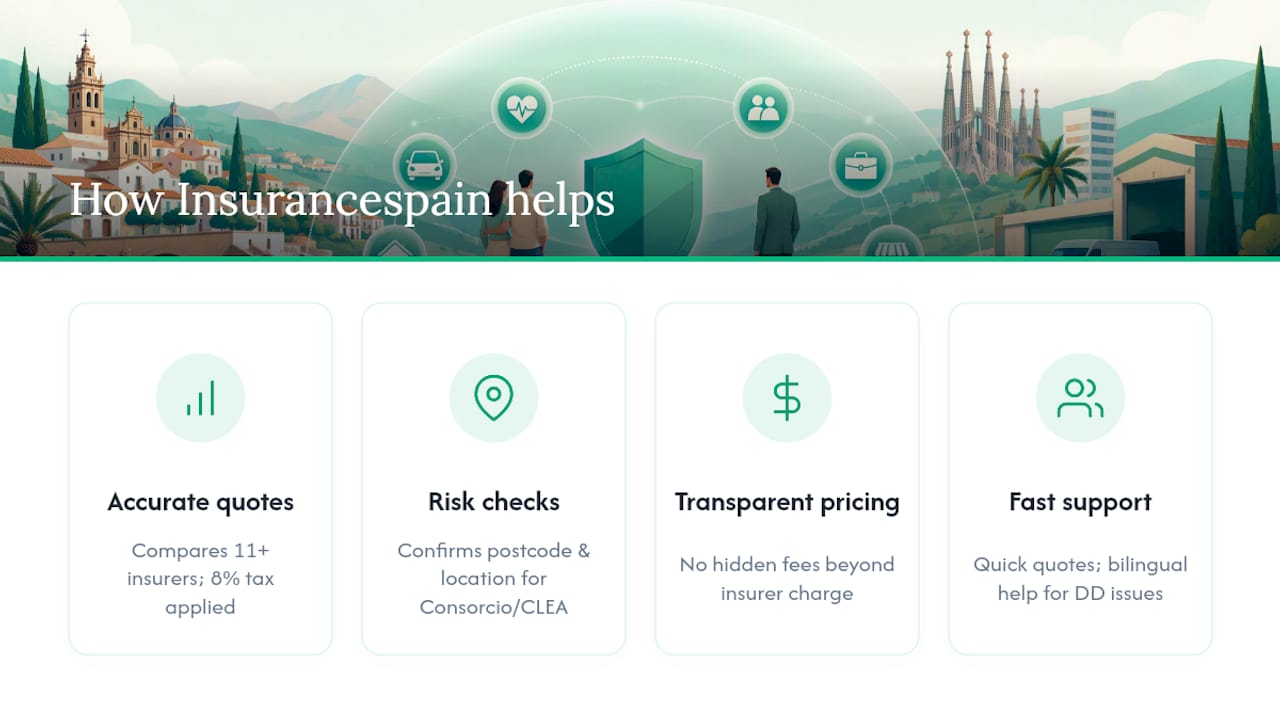
Working through this alone, especially across a language barrier, is where most of the friction lives. Insurancespain compares quotes across more than 11 established Spanish insurers, including Mapfre and Allianz, which means every quote you see already reflects the correct 8% treatment for your specific type of cover, not a headline figure with the tax added on afterwards.
The team confirms your postcode and location-of-risk details before submission, so Consorcio reporting and any CLEA application are handled correctly from the outset. There are no hidden fees layered on top of what the insurer charges, turnaround on quotes is fast, and if a direct-debit query comes up after your policy starts, bilingual support is there to chase it down with the insurer directly.
Three quick actions if something looks off
If you take nothing else from this, do three things. First, ask for the all-in price broken into net premium, IPT and any surcharges before you sign anything. Second, double-check the postcode or location-of-risk on your paperwork, particularly if you have moved provinces. Third, keep your contract copies and flag any direct-debit increase you did not expect within days, not months, while the eight-week reclaim window still applies.
— Jake
Get an IPT-compliant quote without the paperwork headache
Insurancespain exists precisely for the moment you realise a Spanish insurance quote raises more questions than it answers. Rather than chasing five separate insurers in Spanish to compare tax treatment, exemptions and postcode allocation yourself, one bilingual team does that comparison for you across more than 11 providers, and flags anything that looks like a taxable component hiding inside an otherwise exempt policy.

Whether you need motor cover that is correctly taxed from day one, or you want a second opinion on a life policy someone has already quoted you, the process starts with a free, no-obligation comparison. Request a free quote from Insurancespain and get a plain-English breakdown of exactly what you are paying, and why, before you commit to anything.
Where to check the rules yourself
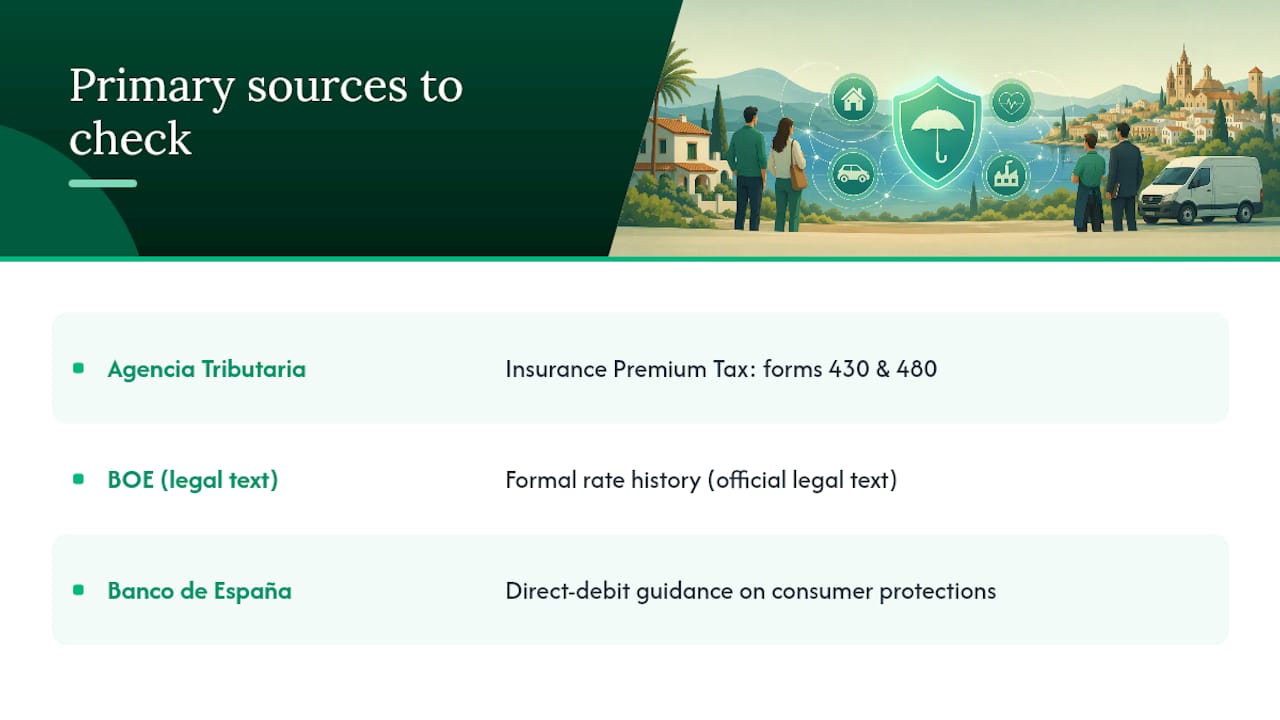
For the primary sources behind everything above: the Agencia Tributaria’s Insurance Premium Tax pages cover forms 430 and 480 in detail, the BOE legal text records the formal rate history, and Banco de España’s direct debit guidance explains your consumer protections in full.
Sources
- Insurance Premium Tax in Spain: Your Questions Answered — Sovos
- Direct debits - Cliente Bancario, Banco de España
- BOE — legal reference
Recommended
Key Takeaways
- ✓ IPT in Spain is 8% on the premium, unchanged since January 2021, and applies to motor, home and liability cover among others.
- ✓ Life and private health insurance are exempt entirely, which removes the 8% loading from those products.
- ✓ The Consorcio extraordinary risks surcharge and the fire brigade charge are excluded from the IPT base and should be shown as separate lines on a proper breakdown.
- ✓ Postcode, or location of risk, is a compulsory field in Consorcio reporting and decides which provincial authority a policy is allocated to, which matters where the Basque territories and Navarra run their own foral regimes.
Frequently Asked Questions
Quick answers on insurance in spain
Still have questions?
Contact us0 Comments
Be the first to leave a comment.


