

€60 or private? Public vs private healthcare for Spain expats
If you’re a legal resident who qualifies through employment, RETA or the S1 form, the public system (SNS) covers you comprehensively and you can stop worrying about monthly premiums. If you’re waiting on residency, self-employed without RETA cover, or applying for a non-lucrative visa, you need a visa-compliant private policy now, with convenio especial as your longer-term public route once you’ve clocked twelve months of legal residence.
TL;DR:
- Public healthcare through the SNS is free for residents with employment, RETA, or S1 form coverage, but waiting times can extend into months for specialist care.
- For those waiting less than a year, applying for a visa-compliant private policy with no copayments or waiting periods is necessary to meet consulate requirements.
- Private insurance offers faster access to specialists and diagnostics but often excludes adult dental, caps mental health support, and charges for prescriptions outside the SNS subsidy.
- The convenio especial costs about €60 per month for residents with one year of legal residence, while private premiums vary by age, starting around €80 to €130 for those under 40.
- Checking the policy’s small print, including exclusions, copayments, and network coverage, is crucial before committing, especially for visa compliance or supplemental health needs.
Table of Contents
- Public vs private healthcare: how Spain’s SNS actually works
- How private health insurance works alongside the SNS
- Public vs private healthcare Spain: costs and how long you’ll actually wait
- Which access route is right for you?
- Coverage gaps: the small print that decides how useful your policy actually is
- How to choose between SNS, private cover, or both
- How Insurance Spain helps you navigate this decision
- An honest take on the trade-offs
- Compare visa-compliant private policies with Insurance Spain
- Sources
Public vs private healthcare: how Spain’s SNS actually works
Spain’s Sistema Nacional de Salud runs on a referral model, not a walk-in one. You register with a GP (médico de cabecera) attached to your local health centre, and that GP acts as the gatekeeper for almost everything beyond basic primary care. Need a cardiologist? You get a volante (referral slip) first. Emergency care is the one exception: turn up at urgencias with a genuine emergency and you’re treated immediately, regardless of your paperwork status.

Coverage under the SNS is genuinely broad. It includes primary care, specialist consultations once referred, emergency treatment, hospitalisation, and major surgery, all without the out-of-pocket shock that surprises many arrivals from countries with insurance-based systems. WHO and OECD assessments consistently rate Spain’s public health system among the stronger performers in Europe, both on clinical outcomes and on the breadth of services it delivers to residents, according to WHO Europe’s health system publications.
Getting into the system depends on which door you walk through:
- Employment or RETA (self-employed): paying Spanish social security contributions gives you automatic SNS access, usually from your first month of registration.
- S1 form: available to certain UK and EU pensioners whose state pension entitles them to reciprocal healthcare cover, transferred into the Spanish system.
- Convenio especial: a paid affiliation route for legal residents who don’t qualify through work or S1, covered in detail below.
The referral structure is efficient for chronic and routine care, but it creates friction for anyone used to booking a specialist directly. Non-urgent waiting lists are the SNS’s most consistent weak point.
Here’s the number that matters most: WHO documentation on Spain’s system does not dispute that clinical quality is high, but it doesn’t claim short waiting times either, and separate market data on the public system shows non-urgent specialist waits commonly stretching into months rather than weeks.
Adult dental care is the other practical gap worth flagging early. The SNS covers dental care generously for children but treats adult dental work, fillings, crowns, orthodontics, largely as a private matter, a distinction that catches a lot of new residents off guard when they book what they assume will be a covered appointment.
How private health insurance works alongside the SNS
Private cover in Spain solves the problem the SNS creates by design: the wait. With a private policy, you typically book a specialist directly, no GP referral, no queue behind emergency cases. Diagnostics such as MRIs and blood panels are often available within days rather than weeks, and private hospitals tend to offer single rooms, shorter admission processes, and more flexible appointment scheduling than their public counterparts.
That speed comes with caveats you need to read carefully before signing anything:
- Dental cover is usually separate. Most private health policies exclude dental care entirely or offer only a discounted add-on, so check this line item specifically rather than assuming it’s bundled.
- Mental health support is often capped. Many policies limit psychology or psychiatry sessions to a set number per year, which matters if you’re managing an ongoing condition.
- Prescription medication is typically paid at the pharmacy counter. Spain’s SNS heavily subsidises prescriptions for enrolled residents; private-only patients often pay closer to full price unless their policy states otherwise.
If you’re applying for a Spanish visa, whether non-lucrative, digital nomad, or another residency category, your private policy must meet a specific bar: no copayments and no waiting periods (carencias), for the full duration of your permit. Consulates and the Oficina de Extranjeros check this closely, and a standard tourist or short-term policy won’t satisfy it. Insurancespain’s visa-compliant health cover for non-lucrative visa applicants is built to those exact consulate standards, which removes the guesswork of checking each insurer’s small print yourself.
Pro Tip: Before you buy any visa-compliant policy, ask the insurer directly whether it includes a “sin copago, sin carencias” clause in writing. Verbal assurances from a sales agent don’t hold up if the consulate rejects your application on a technicality.
Public vs private healthcare Spain: costs and how long you’ll actually wait
Money and time are the two axes that decide this question for most people, so here’s what both actually look like.
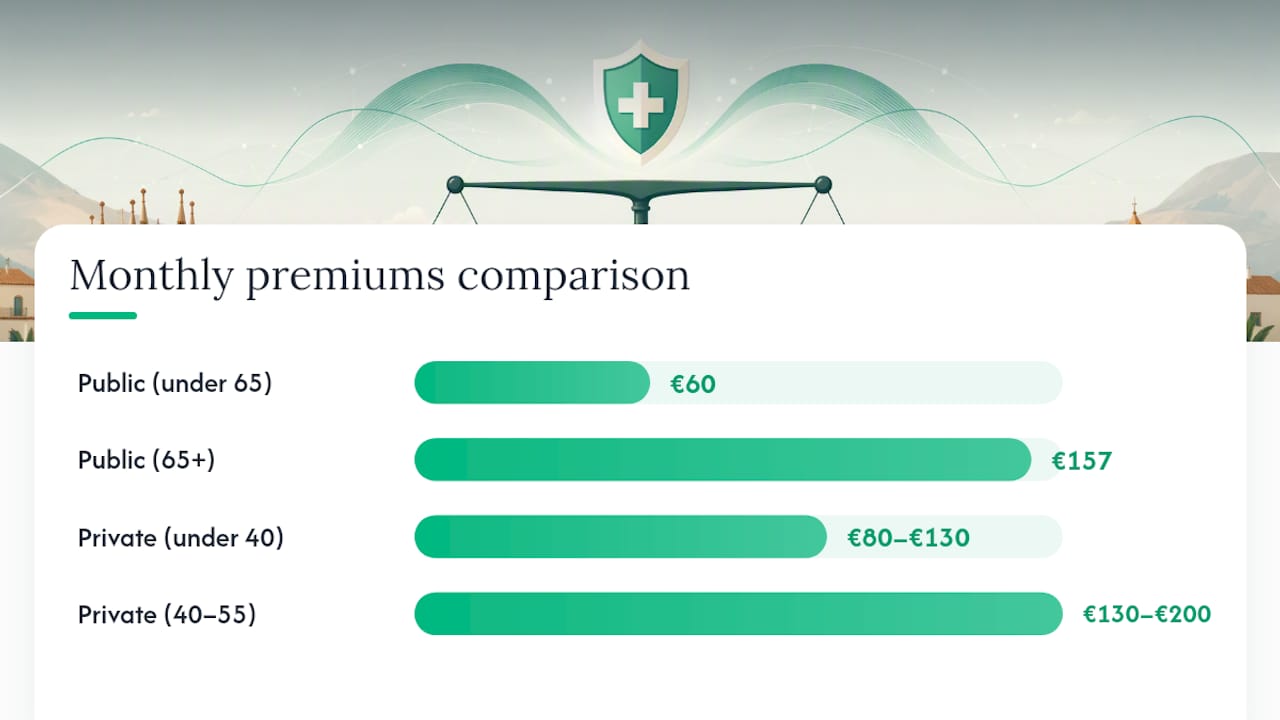
The convenio especial has published, fixed rates, which makes it one of the few predictable numbers in this whole comparison. As of the current official schedule, it costs about €60 a month if you’re under 65, and €157 a month if you’re 65 or older. That fee buys you the full SNS basic benefits package, no copayments, no waiting periods, once you’ve met the eligibility requirement of one year of continuous legal residence.
Private premiums move on a different scale entirely, driven by age, medical history, and how much cover you want:
- Under 40: roughly €80 to €130 per month for a standard comprehensive plan.
- Ages 40 to 55: typically €130 to €200 per month as underwriting risk increases.
- Over 55: premiums rise further still, and insurers may apply exclusions or loadings depending on health declarations.
These are market-representative bands rather than fixed rates, and they shift depending on the insurer and the level of cover, so treat them as a planning guide rather than a quote.
Speed is where the two systems genuinely diverge. A GP appointment is usually fast in both systems, often same-day or next-day. Beyond that, the gap widens. Dermatology and orthopaedic referrals in the public system can take weeks to a few months depending on your region; cardiology waits vary similarly. Private cover typically compresses these to days. Emergency care is the leveller: urgencias treats genuine emergencies immediately whether you’re covered publicly, privately, or not enrolled at all, because triage in Spain runs on clinical urgency, not insurance status.
Which access route is right for you?
Work out which of these applies to you before you buy anything, because the wrong order of operations wastes money and time.
- Are you employed or self-employed (RETA) in Spain? If yes, you’re automatically enrolled in the SNS through your social security contributions. No separate application needed.
- Are you a UK or EU pensioner with a transferable state pension entitlement? Apply for an S1 form through your home country’s pension authority; it grants you SNS access on the same basis as a Spanish contributor.
- Have you been legally resident in Spain for at least one year, with empadronamiento (local council registration) completed? You’re eligible for convenio especial. Apply through your regional health authority with proof of residence and your padrón certificate.
- Are you applying for a visa, or still short of that one year residence mark? You need a visa-compliant private policy in the meantime, one with no copayments and no waiting periods for the length of your permit.
Many expats treat step four as temporary by design, holding a compliant private policy until they qualify for convenio especial or secure work that brings automatic SNS access. Registering on the padrón early matters here: it’s often the single step that unlocks both convenio eligibility and a string of other residency processes, so don’t leave it until last.
Whatever route applies to you, remember that urgencias never asks for your insurance card first. Emergency treatment is available to everyone in Spain, covered or not.
Coverage gaps: the small print that decides how useful your policy actually is
Three Spanish insurance terms determine whether a policy is actually usable day to day, and none of them show up in the headline premium.
Carencias are waiting periods before certain treatments become claimable, sometimes three months for general care, up to a year or more for procedures like childbirth or major surgery on standard policies. Copagos are copayments, a fixed fee you pay per consultation or treatment even with active cover. Cuadro médico is the insurer’s approved network of doctors and hospitals; step outside it and you often pay full price yourself, then claim a partial reimbursement, if any.
These terms shape real-world exclusions beyond the ones already mentioned:
- Adult dental care sits outside almost every standard health policy, requiring a separate dental plan if you want meaningful cover.
- Long-term mental healthcare, ongoing therapy rather than short-term crisis support, is frequently capped at a small number of annual sessions.
- Outpatient prescriptions are commonly excluded from private plans entirely, leaving you paying pharmacy prices out of pocket.
Pro Tip: Ask your insurer three direct questions before signing: What’s the carencia period for the specific treatments I’m most likely to need? Is my current GP or specialist inside the cuadro médico? And what exactly is excluded from copago-free treatment? Advisors generally agree these terms matter more to everyday usability than the price on the quote.
How to choose between SNS, private cover, or both
Work through these in order, because each step narrows the decision faster than jumping straight to price comparisons.
- Confirm your eligibility route first. Employment, S1, or convenio especial each carry different timelines, don’t shop for private insurance before checking whether you already qualify for free public cover.
- Weigh how urgently you need specialist access. If you have an ongoing condition requiring regular specialist input, public waiting lists may push you towards private cover regardless of cost.
- Calculate total monthly outlay, not just the premium. Factor in likely copagos, any separate dental plan, and prescription costs alongside the headline price.
- Read the carencias, copagos and cuadro médico terms line by line before comparing quotes side by side.
- Assess your dental and mental health needs honestly, since both are commonly under-covered by default.
- Check the claims and renewal process with any insurer or broker before committing.
| Expat profile | Likely best route |
|---|---|
| Employed or self-employed (RETA) | SNS via work contributions; private optional for speed |
| UK/EU pensioner with S1 entitlement | SNS via S1; private optional for dental/extras |
| Recently arrived, under one year residence | Visa-compliant private policy now |
| Long-term resident, not employed | Convenio especial once eligible |
| Family with children needing routine paediatric and dental care | SNS for core care, private/dental add-on for gaps |
Ask any insurer or broker these questions at point of sale: What’s excluded from copago-free treatment? Is my nearest specialist inside the cuadro médico? And does this policy meet consulate requirements if I still need visa compliance?
How Insurance Spain helps you navigate this decision
Insurancespain compares policies from over 11 leading insurers, including Mapfre and Allianz, so you’re not left translating Spanish policy documents alone or guessing whether a plan meets consulate standards. The English-speaking team checks that any visa-compliant policy genuinely carries no copayments and no waiting periods before you commit, which matters more than most applicants realise until a consulate flags the gap.
Because the brokerage earns its commission from the insurer rather than charging you a fee, comparing options costs nothing upfront. That matters most when you’re weighing convenio especial timing against an interim private policy, getting the sequence wrong can mean paying for cover you didn’t need or missing a compliance requirement altogether.
An honest take on the trade-offs
Young professionals on RETA rarely need private cover beyond dental, since work-based SNS access already solves the speed problem elective procedures create. Families juggling paediatric appointments and specialist referrals benefit most from SNS plus a modest private or dental add-on. Retirees relying on S1 usually gain more from topping up mental health and dental gaps than from replacing SNS outright.
Keep digital copies of your padrón certificate and S1 form; you’ll need them repeatedly. And always check the cuadro médico before signing, not after your first appointment gets refused.
— Jake
Compare visa-compliant private policies with Insurance Spain
Insurancespain is the practical alternative to spending weeks cross-checking insurer terms yourself, comparing 11+ leading providers in one place so you see genuine no-copago, no-carencia options for visa compliance without wading through Spanish-only policy wording.
Whether you need a bridge policy while your residency clock runs towards convenio especial eligibility, or comprehensive private cover to sit alongside SNS access, the English-speaking team checks the small print for you and flags anything a consulate might reject. There’s no charge for the comparison itself, since Insurancespain works on commission from the insurer, not a fee from you. Get a free comparison of Spain’s leading health insurers and have a compliant policy sorted before your next appointment or visa deadline.
Sources
For eligibility rules and current convenio especial rates, check the Ministerio de Sanidad’s official pages directly, since fees and residency requirements are updated periodically. WHO Europe and OECD publications offer independent assessments of SNS performance, while broker guidance like Insurancespain’s can help you translate the rules into a decision.
This article is general information, not a substitute for advice from a qualified doctor. Consult a qualified healthcare professional about your own circumstances before acting on anything here.
- Ministerio de Sanidad — convenio especial
- WHO Europe — health system publications
- Waypointsur — public vs private healthcare Spain
Recommended
Key Takeaways
- ✓ The convenio especial costs about €60 a month under 65 and €157 a month at 65 or over, but needs one year of continuous legal residence first.
- ✓ Adult dental care sits outside almost every standard private health policy, mental health support is often capped at a set number of annual sessions, and outpatient prescriptions are commonly excluded.
- ✓ Three Spanish terms decide how usable a policy really is: carencias (waiting periods), copagos (copayments) and the cuadro médico (the approved network).
- ✓ Emergency treatment at urgencias is given to everyone in Spain regardless of cover, because triage runs on clinical urgency rather than insurance status.
Frequently Asked Questions
Quick answers on insurance in spain
Still have questions?
Contact us0 Comments
Be the first to leave a comment.


