Under 90 Days in Spain: Travel or Health Insurance?
Most short-term visitors to Spain need travel insurance; residents and long-stay expats need private or international health insurance. Many people, particularly students, digital nomads and anyone splitting time between countries, need both. Some Schengen visa categories also make travel medical cover a legal requirement, not an optional extra.
TL;DR:
- Travel insurance covers trip-specific emergencies like cancellations, lost baggage, and evacuation, with fixed durations and separate evacuation limits.
- Private health insurance in Spain provides ongoing care, including outpatient, inpatient, and chronic condition management, often with waiting periods.
- Relying on only one type of policy can lead to costly gaps, especially since evacuation and trip disruption are generally excluded from health coverage.
- Visa requirements may demand proof of travel medical insurance with specific coverage levels before approval.
- The best approach involves defining stay length, checking evacuation limits, and verifying policy details in English before purchase.
Table of Contents
- Travel vs health insurance: the core differences at a glance
- What does travel insurance actually cover?
- What does private health insurance in Spain cover?
- Where do the two overlap, and where do the gaps become dangerous?
- What drives the cost, and which visa rules matter?
- How do you choose between travel and health insurance?
- What expats get wrong about travel and health insurance in Spain
- Get the right cover arranged without the guesswork
- Sources
Travel vs health insurance: the core differences at a glance
The two products solve different problems, and confusing them is where expats get caught out. Travel insurance is built for the trip itself. It runs for a fixed period, usually a few days to a few months, and exists to handle sudden emergencies away from home. Health insurance, whether a Spanish private policy or an international plan, is built for ongoing life. It runs annually, renews indefinitely, and covers the medical care you’d need whether you’re travelling or not.
The practical differences show up fast once you compare what each one actually pays for:
- Duration: travel insurance is trip-limited; health insurance runs on annual or multi-year terms.
- Core purpose: travel policies handle emergency medical treatment and trip disruption; health policies handle routine and chronic care.
- Evacuation and repatriation: almost always a travel insurance feature, rarely included in standard health cover.
- Trip cancellation, delay and lost baggage: exclusive to travel insurance.
- Visa relevance: some Spanish and Schengen visa categories demand proof of travel medical insurance before entry is granted.
None of this makes one product “better” than the other. They’re simply answering different questions: will I get home if something goes wrong on this trip, versus, will my ongoing healthcare be covered while I live here.
What does travel insurance actually cover?
Travel insurance is built around the assumption that something unexpected happens on a defined trip, and it needs to get you treated, home, or reimbursed. A standard policy for Spain typically includes:
- Emergency medical treatment abroad, usually capped at an amount that varies significantly by provider and plan tier.
- Emergency evacuation and repatriation, which activate when local facilities can’t safely treat you and you need transport to a better-equipped hospital or home.
- Trip cancellation, interruption and delay cover, usually requiring documented proof (a medical certificate, an airline delay letter).
- Lost or delayed baggage, plus passport and document assistance through a 24/7 helpline.
- Standard exclusions around pre-existing conditions, upper age limits, and high-risk activities unless declared and priced in upfront.
Pro Tip: Always check the evacuation limit separately from the general medical limit. A policy advertising “€2 million medical cover” can still cap air ambulance transport at a fraction of that, which matters enormously if you’re hospitalised somewhere remote like the Canary Islands.
What does private health insurance in Spain cover?
Private and international health insurance in Spain is designed for continuity, not emergencies. It assumes you’ll need a GP next month, a specialist next year, and ongoing management of anything chronic. Typical cover includes:
- Outpatient GP and specialist appointments, diagnostics, and chronic condition management (diabetes, hypertension, and similar long-term conditions).
- Inpatient hospital care and elective procedures, usually requiring referral or pre-authorisation through the insurer’s network.
- Prescription medication, though reimbursement rules and formularies vary significantly between insurers.
- Access to a defined hospital and specialist network, with waiting periods (often 6 to 12 months) for non-urgent procedures like maternity or certain surgeries.
A locally underwritten Spanish policy tends to be cheaper but ties you to Spanish hospitals and Spanish-language paperwork unless you choose a bilingual-friendly insurer. International medical insurance costs more but usually covers treatment across multiple countries, which suits expats who move between Spain and elsewhere for work or family. Private health insurance coverage also underpins broader financial protection, since documented links exist between having health insurance and better access to care with reduced financial hardship.
Where do the two overlap, and where do the gaps become dangerous?
The overlap is thinner than most people assume, and the gap is exactly where expensive surprises happen. Evacuation, repatriation, and repatriation of remains sit almost entirely with travel insurance. Trip disruption losses, cancelled flights, lost deposits, curtailed holidays, are covered only by travel policies, never by health insurance. Routine and chronic care continuity sits entirely with private or international health insurance.
Picture four scenarios:
- A two-week holiday to the Costa del Sol: travel insurance only, since you have no ongoing care needs in Spain.
- An Erasmus student on a one-semester exchange: usually travel insurance, unless the stay extends past the policy’s maximum trip length, at which point health cover becomes relevant.
- A temporary work placement of six months or more: private health insurance for routine care, plus travel insurance for any trips home or elsewhere during that period.
- A digital nomad moving between three countries a year: frequently needs both, since neither product alone covers continuous care and constant travel.
Relying on just one policy in the wrong scenario is how people end up paying evacuation costs or full-price specialist bills out of pocket.
What drives the cost, and which visa rules matter?
Premiums move on a handful of predictable factors: age, any pre-existing conditions, the destination territory, trip length, and how generous the cancellation benefits are. A single-trip policy for a typical two-week trip in Spain costs less than an annual multi-trip plan, but frequent travellers usually save money switching to annual cover once they take multiple trips per year.
- Buy travel insurance before departure, ideally the same day you book, since cancellation cover only protects events after the policy starts.
- Private health premiums in Spain typically carry waiting periods of 6 to 12 months for non-emergency procedures.
- Some Schengen visa categories require proof of travel medical insurance covering repatriation and emergency care before a visa is issued, though exact minimums vary by consulate and visa type.
Always verify current thresholds on the official Spanish consulate or Schengen visa page for your specific visa category rather than relying on a general guide, since requirements change and vary by nationality.
How do you choose between travel and health insurance?
Work through this in order rather than shopping on price alone:
- Define your stay length. Under 90 days and no ongoing care needs usually points to travel insurance; longer stays point to health insurance, often both.
- List any pre-existing conditions and confirm in writing whether either policy type excludes or loads premiums for them.
- Check the evacuation and repatriation limits in euros, not just the headline medical limit, since that’s where catastrophic bills originate.
- Ask for the insurer’s definition of “emergency” in writing, since vague wording is where disputed claims happen.
- Confirm the excess, the claims turnaround time, and whether documents are available in English.
Pro Tip: If a seller can’t show you the policy wording in English or hedges on the evacuation limit, treat that as a red flag and ask another provider.
What expats get wrong about travel and health insurance in Spain
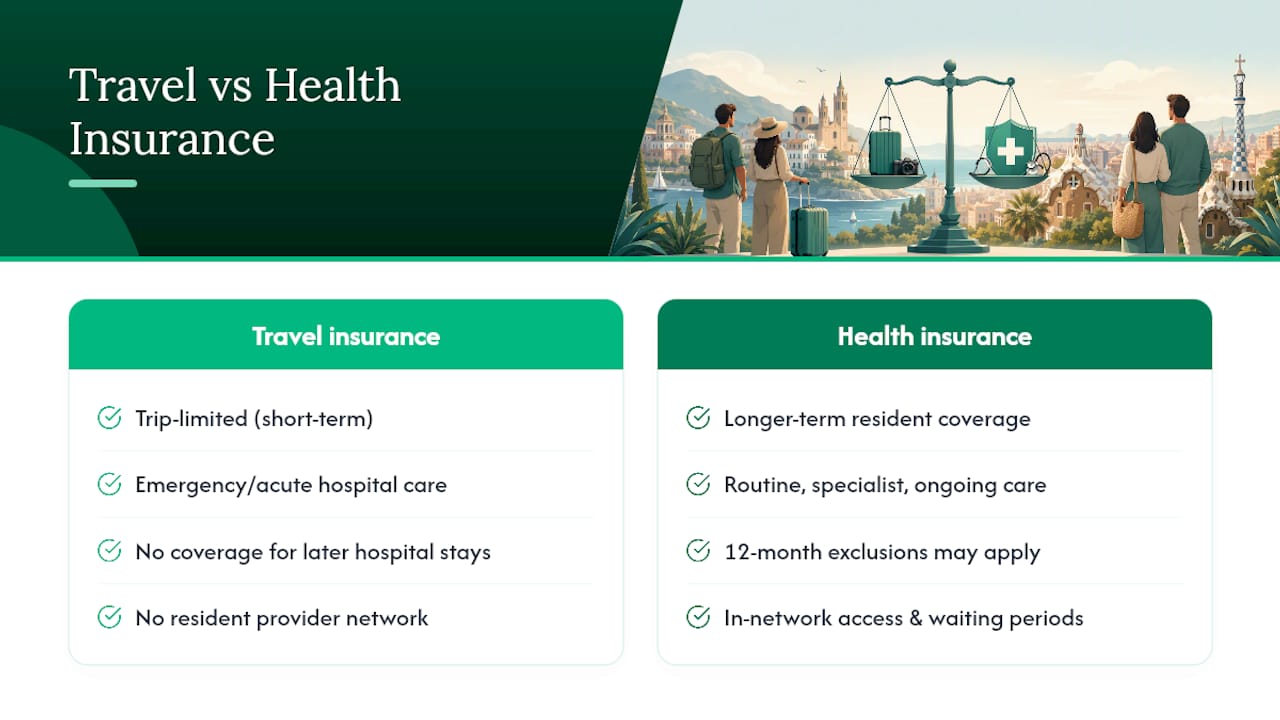
The most common mistake I see is treating travel insurance and health insurance as interchangeable because both have “insurance” in the name. They’re not. A client who moves to Spain and assumes their travel policy from the flight booking site will cover a hospital stay six months later is going to have a very bad conversation with a claims handler.

The second mistake is buying the cheapest health policy without checking network access or waiting periods, then discovering the specialist they need isn’t in-network or the procedure falls inside a 12-month exclusion window. Insurance Spain compares 11+ insurers such as Mapfre and Allianz specifically to catch this before it becomes a problem, with a bilingual, English-speaking team that reads the small print so clients don’t have to. Fast turnaround matters too. Visa deadlines and moving dates don’t wait for paperwork.
— Jake
Get the right cover arranged without the guesswork
Insurance Spain is the practical alternative to piecing this together yourself across insurer websites in Spanish. As a bilingual brokerage, the team compares quotes across 11+ Spanish insurers side by side, explains the difference between a Spanish private policy and an international plan in plain English, and flags visa paperwork requirements before they cause delays.

For expats settling in Andalusia or the Canary Islands, that means one conversation instead of a dozen browser tabs, and no hidden fees buried in Spanish-only terms and conditions. If you’re weighing up a short trip against a longer stay, the team can also clarify whether travel insurance for residents in Spain makes more sense than a full health policy, or whether you need both running side by side.
Start by getting a free comparison on the private health insurance page and see what a properly matched policy actually costs before your next renewal or visa deadline arrives.
This article is general information, not a substitute for advice from a qualified doctor. Consult a qualified healthcare professional about your own circumstances before acting on anything here.
Sources
- Why health insurance matters - NCBI Bookshelf
- Travel insurance vs Medical Insurance - What’s the difference - Wise
- Travel insurance vs health insurance: Key differences explained
- Best travel insurance (methodology example) - Forbes Advisor
Recommended
Key Takeaways
- ✓ Travel insurance is trip-limited and covers emergencies and trip disruption; health insurance runs annually and covers routine, ongoing and chronic care.
- ✓ Check the evacuation limit separately from the general medical limit, because a policy advertising large medical cover can still cap air ambulance transport at a fraction of it.
- ✓ A locally underwritten Spanish policy is usually cheaper but ties you to Spanish hospitals and Spanish-language paperwork; international cover costs more but works across multiple countries.
- ✓ Buy travel insurance before departure, ideally the same day you book, since cancellation cover only protects events after the policy starts.
Frequently Asked Questions
Quick answers on insurance in spain
Still have questions?
Contact us0 Comments
Be the first to leave a comment.