
Yes, almost every private health policy sold in Spain carries waiting periods, known as carencias, for non-emergency treatment. Emergency care is generally covered from your first day of cover. Typical carencias vary depending on the service, and visa applicants often need a policy with no waiting periods at all. If you have a history of cancer, Real Decreto-ley 5/2023 may now work in your favour.
TL;DR:
- Most private health policies in Spain include waiting periods of 3 to 10 months depending on the treatment complexity, with emergency care generally covered immediately.
- Visa applications require health policies with no waiting periods, explicit wording such as “sin carencia,” and authorization by Spanish insurers to be accepted.
- Waiting periods for cancer survivors have been reduced to five years after radical treatment, but only if the policy was signed after June 2023 and the applicant provides proper medical evidence.
- Always request written confirmation of carencia schedules and verify policy wording before purchasing to avoid rejection or coverage gaps in visa application processes.
- Insurers may offer no-waiting-period plans at a higher premium, and comparing these options is essential for urgent or visa-related cover needs.
A carencia is a fixed stretch of time, set out in your policy contract, during which the insurer will not pay for a specific type of treatment even though your cover is active. It starts running from the date your policy takes effect, or from the date a new person or new benefit is added to an existing policy. Buy a plan in January with a six-month carencia for diagnostic imaging, and you cannot claim for an MRI until July, even though your premium was due from day one.
This is a different mechanism from an exclusion or a pre-existing condition clause. An exclusion removes a service from cover permanently, no matter how long you have held the policy. A pre-existing condition clause deals with something you had before you signed up, which insurers assess separately through the health questionnaire you complete on application, and which you must answer honestly. Get that questionnaire wrong and the insurer can void the whole policy later, waiting period or not.
Insurers use carencias to stop people buying cover the week before major surgery and cancelling it the week after. Certain services are usually exempt from the start:
Always check the policy wording rather than assume; “emergency” is defined contract by contract.
Waiting periods scale with the complexity and cost of the treatment involved, and the pattern is fairly consistent across the market. Minor procedures come with short carencias; anything involving a hospital stay, specialist input, or planned childbirth takes longer to unlock.
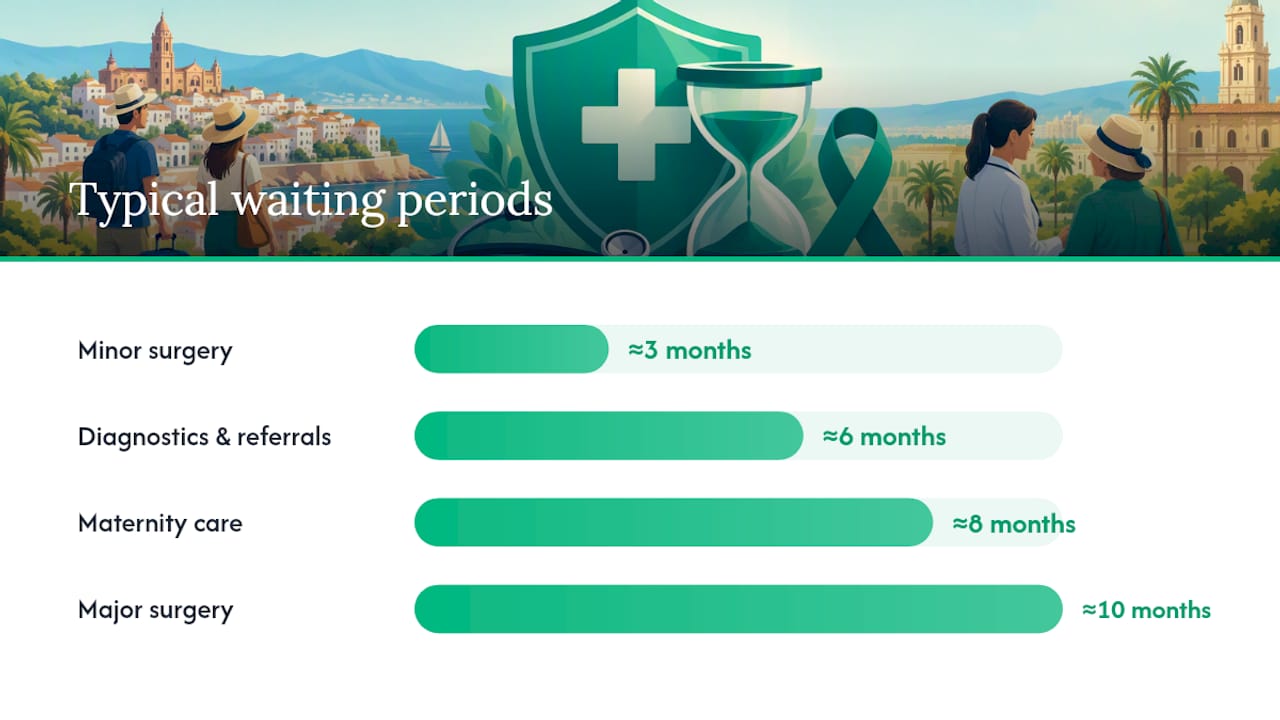
Representative benchmarks that insurers commonly apply to include:
Pro Tip: These are typical ranges quoted by industry explainers, not fixed law. Two insurers can set different carencias for the same treatment, so always ask for the schedule of waiting periods in writing before you sign, not after.
The logic behind the scale is straightforward. A minor procedure carries low financial risk for the insurer, so a short carencia is enough to deter opportunistic buying. Maternity and major surgery represent far larger, near-certain payouts once claimed, so insurers extend the qualifying period to spread that risk across a longer premium history.
Whatever the service, urgent and emergency care sits outside this system. If you are admitted after an accident or a sudden medical crisis, waiting periods normally do not apply, though you should still confirm this explicitly in your contract rather than assume it from a marketing brochure.
Spanish residency visas are where waiting periods stop being a personal inconvenience and start being a legal obstacle. Non-Lucrative Visa applications, and many Digital Nomad Visa checklists, require a private health policy with no waiting periods, no co-payments, and no deductibles, matching the public healthcare system’s scope of cover. A policy that is technically excellent but carries a six-month carencia on diagnostics will usually be rejected outright.
Consulates check specific wording on the insurance certificate itself, not the policy brochure. When preparing documentation, look for these elements:
Three mistakes cause the most rejections. Applicants submit a brochure or app screenshot instead of a formal certificate. They buy a reimbursement-only travel policy, which pays you back after treatment rather than granting direct access to a Spanish provider. Or they choose an insurer that is not authorised to operate in Spain, however well known it is elsewhere. Consulates prioritise certificate wording over marketing claims, and a non-authorised or reimbursement-only policy is one of the most common reasons a visa file gets sent back.
Real Decreto-ley 5/2023 introduced the derecho al olvido oncológico, the right to be forgotten for former cancer patients, into Spanish insurance law from June 2023. The rule states that once someone has completed radical treatment and remained disease-free for a significant disease-free interval, that cancer history cannot be used against them when they apply for or renew life or health insurance. The Ministry of Health’s own announcement frames this as closing a gap where survivors faced permanent surcharges or exclusions long after recovery.
The rule has limits. It applies specifically to the disease-free interval following radical treatment, and the DGSFP’s own guidance sets out how that five-year count is calculated and how it should affect renewals, not just new applications.
For contracts signed before 30 June 2023, the law does not apply automatically. UNESPA, the Spanish insurers’ association, published a voluntary good-practice guide asking member insurers to review older policies case by case and remove surcharges or exclusions once a survivor provides evidence of the five-year threshold.
If this applies to you:
Before signing anything, ask the insurer for a written schedule of carencias covering every major service category, not just a verbal summary from a sales call. Demand the exact certificate wording you will need if the policy supports a visa application: “sin carencia,” “sin copago,” and confirmation of Spanish authorisation.
Three practical steps narrow the risk of a nasty surprise later:
Pro Tip: A no-waiting-period plan almost always costs more and may offer a smaller hospital network than a standard plan with carencias. Decide which trade-off matters more: paying extra now for immediate direct access, or accepting a cheaper plan and waiting out the carencia on non-urgent treatment.
Start with a formal written complaint to the insurer’s own customer service or complaints department, referencing your policy number and the specific clause in dispute. Spanish insurers are generally required to respond within a set timeframe, and their reply should explain the decision in writing, not just over the phone.
If the response is unsatisfactory or absent, the next step is Spain’s insurance regulator, the Dirección General de Seguros y Fondos de Pensiones (DGSFP), which handles consumer complaints against insurers operating in the Spanish market. Realistic outcomes include a reassessment of your case or a formal ruling on whether the insurer applied the contract correctly, though the DGSFP cannot force a company to pay a claim it deems contractually invalid.
Before escalating, collect:
Clients frequently assume a policy is visa-ready because it “sounds comprehensive,” without checking for explicit “sin carencia” wording on the certificate itself. We help clients match policy wording to consulate requirements before they submit, which avoids delays that can cost weeks in an application process.
— Jake
Chasing down carencia tables, certificate wording, and Spanish authorisation across a dozen insurer websites is exactly the kind of task that eats a weekend and still leaves you unsure you got it right. Insurancespain compares private health insurance options across more than 11 leading Spanish insurers in English, checking waiting periods, co-payment terms, and certificate wording against what your visa application or consulate actually needs, rather than what a brochure promises.
The process is free and carries no obligation: you tell us what you need cover for, whether that is a Non-Lucrative Visa application, a Digital Nomad Visa, or simply better-value ongoing cover, and our bilingual team checks the fine print so you do not have to. If you are unsure whether your current policy’s wording will satisfy a consulate, or you want a side-by-side comparison of no-waiting-period plans, get a free quote through Insurancespain and have your documentation checked before you submit it.
This article is general information, not a substitute for advice from a qualified doctor. Consult a qualified healthcare professional about your own circumstances before acting on anything here.
Under private insurance, waiting periods vary by service, typically 3 months for minor surgery, 6 months for diagnostics and specialist referrals, 8 months for maternity, and up to 10 months for major surgery. Emergency care is generally covered from the day your policy starts, so the wait applies only to planned, non-urgent treatment.
Some insurers in Spain offer policies with no waiting periods at all, usually at a higher premium, aimed largely at visa applicants who need immediate full cover. Insurancespain compares these no-carencia options against standard plans so you can weigh the cost difference against the speed of access.
A waiting period, or carencia, is a set stretch of time after your policy starts during which a specific treatment is not covered, even though your premium is already being paid. It differs from an exclusion, which removes cover permanently, and from a pre-existing condition clause, which relates to health issues you had before joining.
Pre-existing conditions are usually handled through the health declaration on your application, not a standard carencia, and insurers may exclude, surcharge, or decline cover for them entirely rather than apply a fixed waiting period. The exception is cancer survivors covered by Real Decreto-ley 5/2023, whose history cannot be held against them once they pass the five-year disease-free threshold after radical treatment.
Be the first to leave a comment.
