
Spain’s insurance law does not require a medical exam for life insurance. Under Ley 50/1980, you must answer a health questionnaire truthfully, and insurers decide case by case whether that questionnaire justifies a physical exam. Age, requested sum assured, and flagged health answers are the usual triggers, and no-exam alternatives exist if you prefer to avoid the process altogether.
TL;DR:
- Age, sum assured, and health answers primarily determine whether a medical exam is required, especially for applicants over 55 or requesting high payouts.
- Insurers in Spain use the health questionnaire as the main underwriting tool, and inaccuracies or omissions can lead to policy voidance or claim denial.
- A medical exam, when necessary, involves routine tests like blood, urine, vitals, and possibly an ECG, with results usually available within weeks.
- No-exam options such as simplified, guaranteed, or digital underwriting offer quicker approval at the cost of higher premiums or lower coverage limits.
- Working with a broker can help expats avoid common mistakes, efficiently coordinate exams, and find the best underwriting route for their profile.
The health questionnaire, not the medical exam, is the legal backbone of a Spanish life insurance contract. Article 14 of Ley 50/1980 places a clear duty on you as the applicant: answer every health question the insurer puts to you honestly and completely, before the policy is agreed. There is no equivalent clause forcing an insurer to send you for a physical exam. That decision sits entirely with the underwriter, based on what your answers reveal and how much risk they are being asked to take on.
This matters more than most applicants realise. The questionnaire is not a formality you rush through at the end of an online form. It is a contractual document, and insurers treat it that way. When a claim is filed, particularly in the early years of a policy, the insurer will often go back to that questionnaire to check whether your original disclosures match your actual medical history.
Get it wrong, deliberately or by omission, and the consequences scale with intent:
A medical exam, where one is requested, exists largely to verify what you have already told the insurer. Insurers frequently cross-check disclosures against medical records databases during underwriting, particularly for conditions declared in the past five to ten years. Accuracy on the questionnaire protects you far more than a clean exam result ever will.
Spanish insurers use the questionnaire as the first filter and reserve the medical exam for higher risk cases that the questionnaire alone cannot resolve. Several factors push an application into that category:
As a rough guide, a 30 year old applying for €150,000 of cover with no health concerns will usually clear underwriting on the questionnaire alone. A 58 year old applying for €400,000 with a history of high blood pressure is a near certainty for an exam. Insurers vary in exactly where they draw these lines, and one company’s threshold for automatic approval can be another’s trigger for further testing.
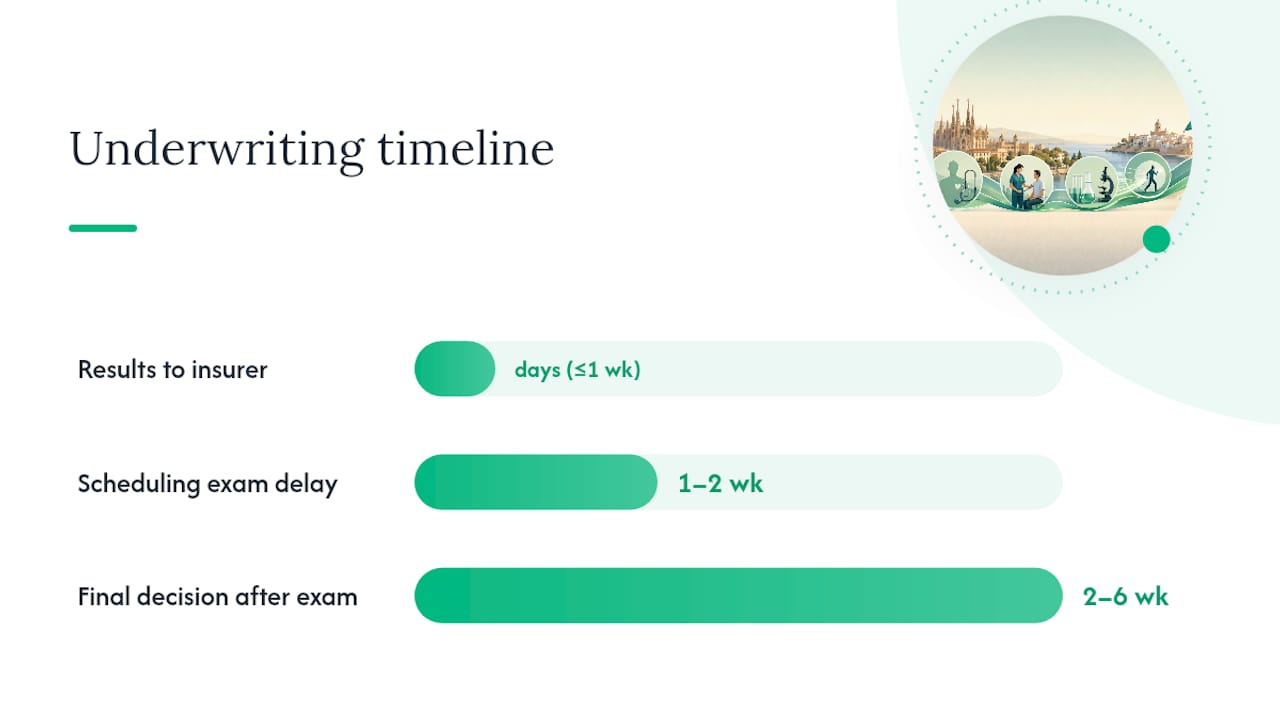
Underwriting timelines: from the point an exam is requested, results typically reach the insurer within days, and the full underwriting decision commonly lands within two to six weeks of the exam being completed. Scheduling the exam itself, particularly in areas with fewer partner clinics, can add another week or two if appointments are limited.
If your application is flagged for a medical exam, the process is more routine than most applicants expect, and it costs you nothing. The insurer arranges and pays for it, usually through a partner clinic or a visiting nurse.
The whole appointment typically takes a short amount of time. A qualified nurse, paramedic, or clinic partner conducts it, rather than the insurer’s own staff, and in many cases the exam can be arranged at your home or workplace rather than requiring a clinic visit.
Once results land with the underwriter, outcomes range from standard approval to approval with premium adjustments or specific exclusions based on risk. Occasionally, an abnormal result prompts a request for further tests or a delay while the insurer requests clarification from your GP. None of these outcomes are unusual, and none should be treated as a red flag in themselves.
A little preparation goes a long way towards an accurate result, and an accurate result is what actually protects your premium.
If your blood pressure spikes on the day, perhaps from nerves or a rushed morning, you can usually request a retest rather than accepting a one-off anomalous reading as final.
Pro Tip: If you manage a controlled condition, such as treated hypertension or stable thyroid levels, bring your most recent test results and specialist letters to the exam. Submitting evidence that a condition is well managed often speeds up underwriting and can prevent an unnecessary loading on your premium.
You are not obliged to accept a medical exam route if it does not suit your circumstances. Three main no-exam paths exist in the Spanish market, and increasingly, digital insurers offer questionnaire-only underwriting for specific age bands and sums, subject to standard DGSFP regulatory oversight.
The trade-off is consistent across all three: speed and simplicity in exchange for higher premiums, lower maximum sums, or restricted benefits in the early policy years. These options suit specific profiles well, particularly older applicants seeking smaller funeral or final-expense cover, or anyone who needs cover in place quickly and is willing to accept a lower payout ceiling in return. For a healthy 35 year old wanting substantial cover, a medically underwritten policy will almost always offer better long-term value.
Deciding whether to accept an exam or opt for a no-exam route is easier with someone who knows how individual Spanish insurers actually underwrite. Insurance Spain compares appetite across more than 11 providers, including Mapfre and Allianz, and liaises directly with clinics in English so nothing gets lost between your GP and the underwriter.
Brokerage support frequently speeds up the whole process by making sure your questionnaire is complete, pre-collecting medical records for anything you have declared, and scheduling exams before delays creep in. That matters most when you are weighing a fully underwritten policy against a simplified option and need a straight answer about which suits your health profile and budget.
The mistakes I see most often are avoidable. Incomplete disclosure tops the list, usually not through dishonesty but through applicants assuming a minor condition “doesn’t count.” Others assume every online no-exam offer is equivalent, when sums and exclusions vary sharply between providers.
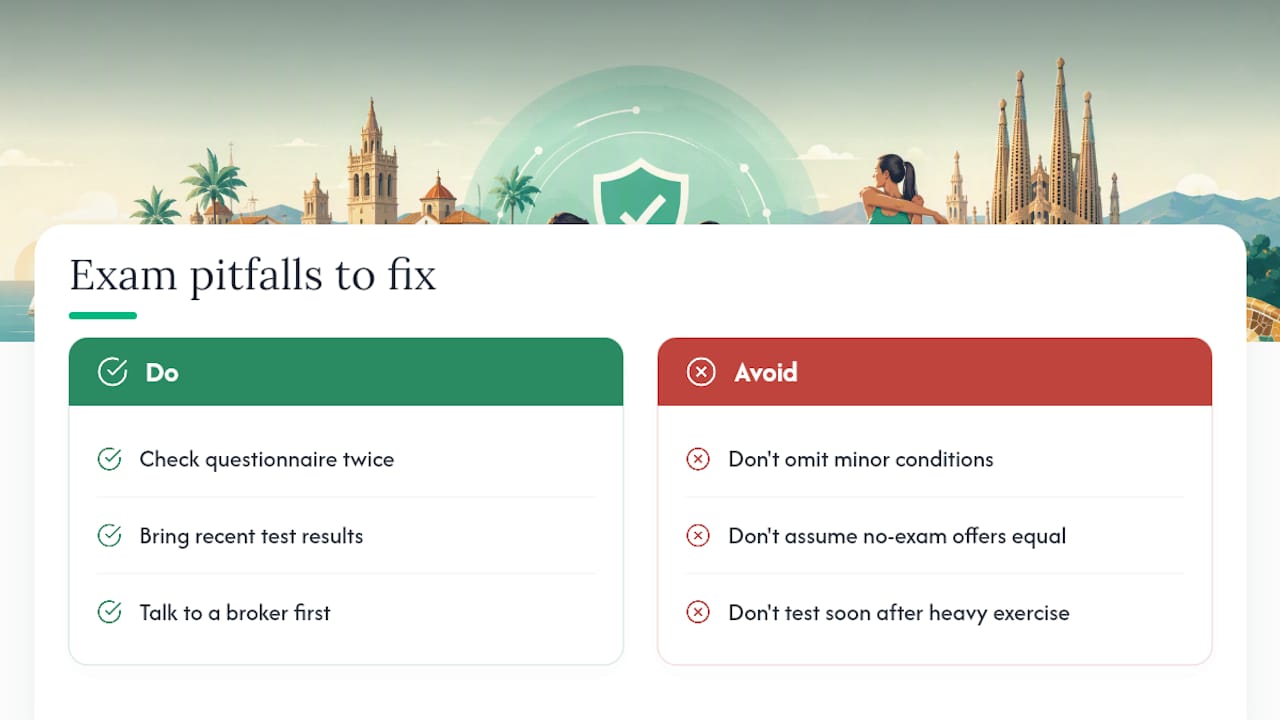
Poor timing causes needless retests. Booking a fasting blood test after a heavy weekend, or straight after a gym session, invites an abnormal reading that then triggers further scrutiny. And too few applicants keep recent specialist letters ready for a controlled condition, which is the single easiest way to avoid a premium loading.
Fix these three things before you apply: check your questionnaire twice, gather any recent test results for known conditions, and talk to a broker before you commit to either an exam or a no-exam product.
— Jake
Working out whether to accept a medical exam, push for a simplified-issue policy, or go fully digital is not a decision to make from a comparison website alone. Insurance Spain is the alternative to guessing your way through a Spanish insurer’s underwriting rules: its English-speaking team compares appetite across more than 11 providers and handles the clinic liaison and paperwork on your behalf, at no direct cost to you.
Whether you are 34 and expect a straightforward questionnaire-only approval, or 61 and bracing for an ECG, getting the right guidance before you apply saves weeks of back-and-forth. If disability or income disruption is also a concern alongside life cover, it is worth reviewing income protection options at the same time. Request a personalised comparison through Insurance Spain and find out which insurer, and which underwriting route, actually fits your situation before you fill in a single questionnaire.
This article draws on Spanish insurance law and established underwriting practice, alongside Insurance Spain’s own brokerage experience with expat clients.
Plaats als eerste een reactie.
