
Third-party liability is the legal minimum for every car registered in Spain, but for most expats it isn’t the sensible choice. If your car is worth more than a few thousand euros, is financed, or sits on an unsecured street overnight, comprehensive (‘todo riesgo’) is usually the better fit because it covers your own vehicle, not just the other party’s. The sections below break down each cover level and give you a checklist to compare policies properly.
TL;DR:
- Comprehensive insurance is advisable for cars under finance, newer than five years, or parked in high-risk urban areas due to higher potential repair costs.
- The actual price difference between third-party and comprehensive policies varies based on vehicle value, driver age, location, and excess amount, making side-by-side quotes essential.
- Spain’s law requires only third-party liability coverage, but comprehensive policies offer broader protection and can positively influence resale value and vehicle maintenance.
- Exclusions in comprehensive policies, such as unlisted drivers or use for racing, should be carefully reviewed before signing to avoid claim rejections.
- Working with a bilingual broker simplifies comparing policy options and ensures understanding of actual cover levels and territorial limits across insurers.
Third party (terceros) pays for damage or injury you cause to someone else. It never pays to fix your own car. Comprehensive (todo riesgo) does both: it covers third-party liability plus damage to your vehicle, whether that’s a collision, vandalism, or a cracked windscreen.
Consider comprehensive if any of these apply to you:
Premiums for comprehensive typically run higher than third party, though the gap narrows for older vehicles with low market value. The only reliable way to know the real difference for your car is to run quotes side by side rather than guess from headline pricing.
Spain requires every registered vehicle to carry compulsory third-party liability insurance, known as seguro obligatorio. This covers injury or damage you cause to other people, their vehicles, or their property. It says nothing about your own car.
Because Spain sits inside the EEA, this compulsory cover travels with you. EU guidance confirms that a vehicle registered in any EU country must carry compulsory third-party insurance, and that cover is valid across the whole EEA. That’s useful if you’re driving to France or Portugal for a weekend, but it’s worth checking your policy schedule first: voluntary extras like breakdown cover or a courtesy car often carry their own territorial limits, even when the compulsory liability portion doesn’t.
Spain’s own guidance on this is unambiguous: compulsory insurance covers damage to third parties and applies to any vehicle registered in an EU country, with voluntary extras like todo riesgo added on top. For the precise statutory wording, and any recent amendments to fines or obligations, the BOE carries the current legislative text. Rules do get updated, so it’s the source to check before assuming last year’s figures still apply.
Terceros básico is the bare legal minimum. It pays third-party claims and nothing else. If someone keys your car in a car park or a hailstorm smashes your windscreen, básico leaves you paying for repairs yourself.
Terceros ampliado builds on that base with cover most drivers actually want:
Beyond these two tiers, insurers sell add-ons regardless of which base policy you hold:
If your car is worth keeping on the road but not worth insuring fully, ampliado plus a couple of these extras often lands close to comprehensive pricing without the full own-damage cover.
Todo riesgo adds daños propios, own-damage cover, on top of everything third party and ampliado already provide. That means collision damage regardless of fault, vandalism, and theft of the vehicle itself, not just its contents.
Most comprehensive policies bundle in extras as standard: a courtesy car while yours is repaired, glass replacement, legal assistance, and 24/7 roadside support. These vary between insurers, so treat them as common rather than guaranteed.
What trips people up is the exclusions. Standard comprehensive policies typically will not pay out if:
Read the condiciones particulares before you sign, not after a claim gets rejected. The headline word “todo riesgo” translates loosely as “all risk,” but no Spanish comprehensive policy is genuinely all risk. Every one carries a list of exclusions worth five minutes of your attention.
The excess, or franquicia, is the amount you pay out of pocket before the insurer covers the rest of a claim. Spanish insurers commonly offer excess bands around €200, €300, €500, and €1,000, and choosing a higher one tends to lower your premium in exchange for carrying more risk yourself.
A €500 excess on a minor bumper scrape means you pay the first €500; the insurer covers anything above that. It works well for older cars where repair costs rarely exceed a few hundred euros anyway. It works badly for a financed or newer vehicle, where a single claim could easily blow past a high excess and leave you no better off than going without cover at all.
Rather than comparing insurer brand names, compare what’s actually printed on the policy schedule. Use this as your checklist:
Marketing names for these tiers vary between insurers, and one company’s “extended” tier might include what another calls an optional extra. The policy schedule, not the product name, tells you what you’re actually buying.
Work through these factors in order of importance for your situation:
When you’re comparing quotes, ask the insurer or broker these questions directly:
Pro Tip: Keep every old policy document and claims history letter from your previous insurer, even from another country. Spanish insurers almost always ask for formal proof before they’ll honour a no-claims bonus transfer, and a verbal claims history isn’t enough.
The most frequent error is assuming Spanish insurance works like a UK policy. In the UK, some cover follows the driver across different cars; in Spain, cover is almost always tied to the vehicle itself. Bring a UK mindset into a Spanish quote and you’ll misjudge what’s actually protected. Gov is a useful starting point for UK-origin drivers, but it’s a summary, not a substitute for reading your Spanish policy terms.
No-claims bonus transfers cause the second most common headache. Spanish insurers want documented proof of your claims history, not just your word for it, so gather old policy schedules and renewal letters before you request quotes.
Imported or UK-registered vehicles bring a third layer of complexity; for practical advice on moving and registering such vehicles, see транспорт на автомобили от чужбина. A car still on UK plates that’s now based in Spain typically needs Spanish registration and Spanish-compliant cover, not a UK policy stretched across the border. If you’re mid-process on an imported vehicle, sort registration before you assume any policy, third party or comprehensive, is valid.
The claims path splits sharply depending on who’s at fault and which cover you hold. Under third-party-only insurance, if you cause an accident, your insurer deals with the other driver’s damage and injury claims directly, but if your own car needs fixing, you’re on your own; there’s no claim to file with your own insurer because there’s nothing in your policy that pays for it.
Comprehensive cover changes that entirely. You file a claim with your own insurer for your own vehicle’s damage, regardless of fault, alongside whatever process handles the third party’s claim. That typically means submitting photos, a police report for anything involving injury or significant damage (mandatory above certain thresholds), and sometimes an independent assessor’s inspection before repairs are approved.
Fault matters more under comprehensive because it affects your no-claims bonus even when the insurer pays out. A claim where you’re not at fault, say a parked car gets hit while you’re inside a shop, usually doesn’t touch your no-claims record, provided you can identify the other party or their insurer accepts liability. A single-vehicle claim where you’re clearly at fault almost always does.
Repair timelines also diverge. Comprehensive policies with an approved workshop network tend to move faster because the insurer has a direct billing relationship with the garage. Third-party-only claims involving another driver’s insurer can take longer, since you’re relying on a company you have no contract with to process and pay out.
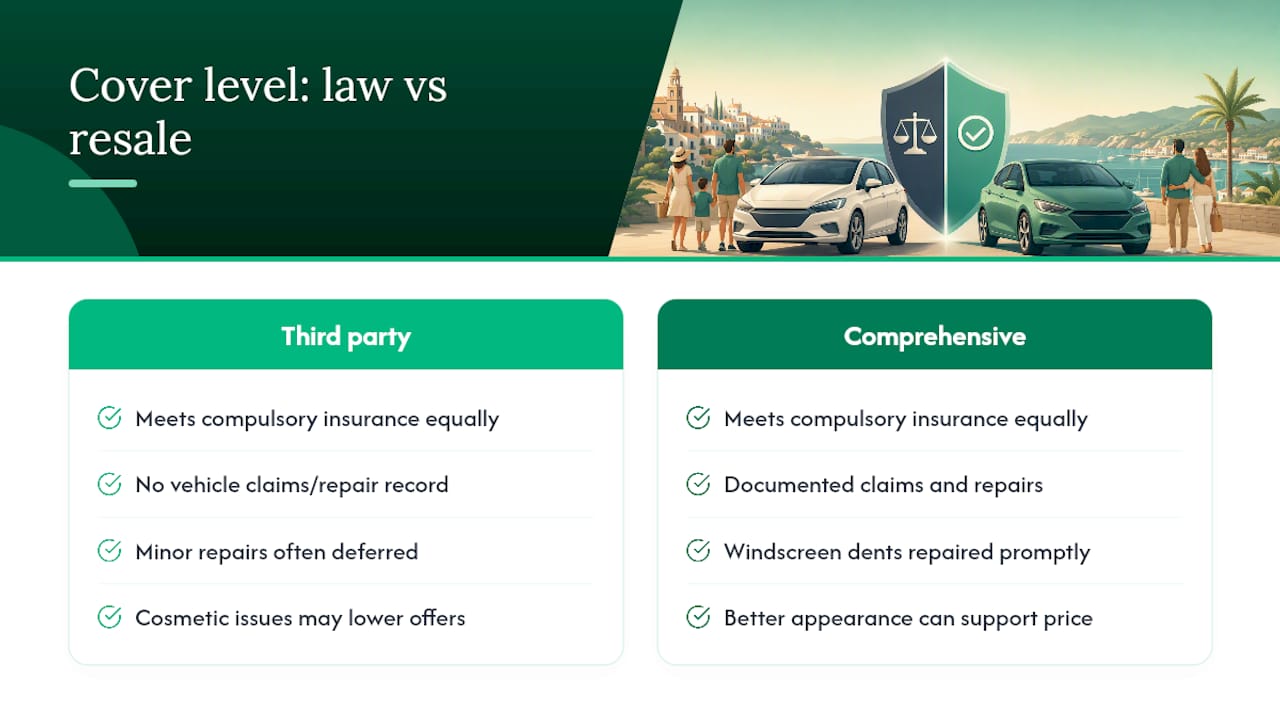
Legally, both third party and comprehensive satisfy Spain’s compulsory insurance requirement equally. The DGT (Dirección General de Tráfico), Spain’s traffic authority, doesn’t distinguish between cover levels when checking whether a vehicle is legally insured; it only checks that valid compulsory liability cover exists. Driving with no insurance at all, regardless of which tier you’d otherwise choose, exposes you to fines and potential vehicle impoundment.
Resale value is a different question, and it’s where comprehensive quietly pays off. A car that’s been comprehensively insured throughout its life in Spain typically has a documented claims and repair history attached to it, which matters to a buyer or a dealer assessing condition. A car insured only third party has no such record, because there was never a mechanism to log or pay for damage to the vehicle itself, minor knocks simply went unrepaired or unrecorded.
There’s also a practical link between comprehensive cover and vehicle condition at resale. Owners who carry todo riesgo tend to get windscreen chips, minor dents, and paintwork issues repaired promptly, since the policy often covers it with a low or no excess. Third-party-only owners frequently defer these repairs because they’d be paying out of pocket, and small cosmetic issues left unaddressed for years do affect what a buyer is willing to pay.
Neither cover level changes your legal right to sell or register the vehicle. What changes is the paper trail a buyer can request, and how well-maintained the car looks after several years on Spanish roads.
Spain’s motor insurance market includes large national insurers, regional players, and direct-to-consumer online providers, each structuring their third-party and comprehensive products slightly differently. Product names differ between companies even when the underlying cover is similar, which is part of why comparing policy schedules matters more than comparing brand names.
Larger insurers typically publish clear tiered product ranges, terceros, terceros ampliado, and todo riesgo, with glass, legal defence, and roadside assistance sold as optional extras layered onto any tier. Smaller or regional insurers sometimes bundle more into a mid-tier product to compete on price, which can make a “basic” policy from one company look closer to “extended” from another.
For expats specifically, the practical difference isn’t which insurer’s logo is on the policy, it’s whether the process happens in a language you’re confident navigating, and whether a claim gets handled quickly if something goes wrong. This is where working through a bilingual broker rather than approaching insurers individually tends to save time: a broker who already knows how each insurer structures cover can flag which policy actually matches what you think you’re buying, rather than you discovering the gap after an accident. Comparing car insurance options in Spain through a single point of contact avoids the trap of requesting quotes from several companies in Spanish and trying to reconcile different terminology yourself.
A few scenarios illustrate why comprehensive tends to justify its higher premium for the right driver. Picture a single-vehicle accident on a wet mountain road near Alicante, no other car involved, just a skid into a barrier. Third-party liability pays nothing here, because there’s no third party to compensate. Comprehensive covers the repair in full, minus your excess.
Vandalism is another common trigger. A scratched car door or a smashed side mirror in an unsecured street parking spot in a city like Valencia is exactly the kind of low-value, high-frequency damage that third-party-only owners end up paying for themselves, year after year, because the amounts rarely feel large enough individually to justify comprehensive, until they add up.
Theft scenarios make the case even more sharply. A stolen catalytic converter or a full vehicle theft from outside a rented apartment leaves a third-party-only owner with no recourse beyond a police report and a replacement vehicle they’re funding entirely themselves. Comprehensive with theft cover, standard from terceros ampliado upward, at least gets partial or full compensation moving.
The scenario where third party remains the rational choice is the low-value, low-usage vehicle: an old runaround worth a few hundred euros, parked securely, driven rarely. Here, the premium saved on comprehensive over several years likely exceeds what you’d ever recover from a claim on a car that cheap to replace outright.
Several factors push premiums up or down independently of which cover tier you choose, and they interact with each other in ways that make blanket price comparisons unreliable. Vehicle age and value matter most: a new or high-value car costs more to insure comprehensively because the insurer’s potential payout is larger, while third-party pricing for the same car depends more on engine size and driver risk than on the car’s own worth.
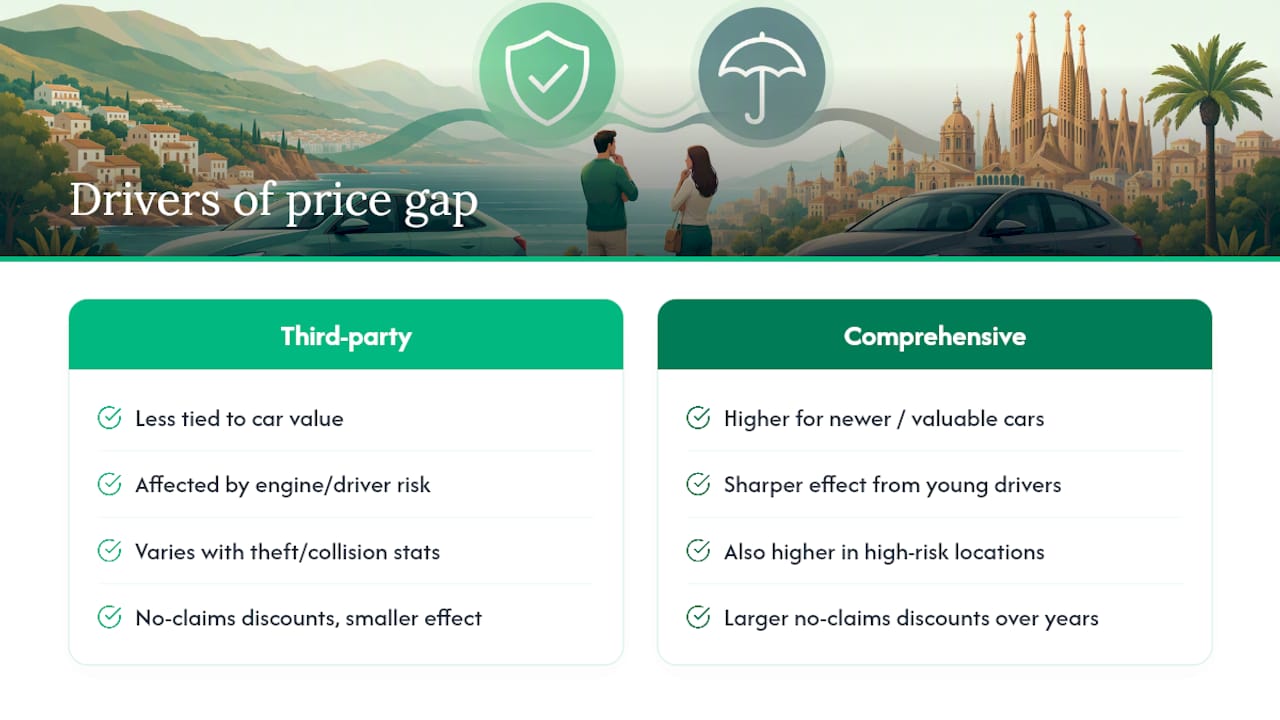
Driver age and experience shift pricing across every tier, but the effect is usually sharper on comprehensive, since insurers weigh both liability risk and the likelihood of an at-fault claim against your own vehicle. A driver in their twenties with a Spanish licence issued within the past two years will typically see a wider gap between third party and comprehensive quotes than a driver in their forties with a decade of no-claims history.
Location plays a real role too. Insuring a car garaged in a small Andalusian town generally costs less across both tiers than insuring the same car parked on a busy Balearic Islands street overnight, reflecting theft and collision statistics tied to population density and tourism traffic.
No-claims history compounds across renewal years, and the discount it earns tends to apply more generously to comprehensive premiums, since insurers have more to lose on an own-damage claim than a straightforward liability one. The only reliable way to see how these factors combine for your specific car is to check current cost ranges and request quotes across a few insurers rather than relying on a single number.
Working out whether third party or comprehensive fits your situation is easier with someone comparing quotes on your behalf, rather than requesting them yourself across multiple Spanish-language sites. Insurance Spain compares policies from 11 or more Spanish insurers and explains the differences in English, which matters when policy wording carries real legal weight.
Practical support includes checking policy documents before you sign, helping gather the paperwork insurers ask for during a no-claims transfer, and assisting if you ever need to make a claim and want it handled without a language barrier slowing things down. For anyone moving from a UK or other foreign licence and policy history, that bilingual layer often catches gaps a direct online quote would miss.
— Jake
Comparing third party against comprehensive across several Spanish insurers yourself means requesting quotes in Spanish, decoding different product names, and hoping you’ve spotted every exclusion. Such brokers do that comparison for you, free, in English, across more than a dozen providers, with no hidden fees added on top of what the insurer already charges.

Before you request a quote, have your vehicle registration document (permiso de circulación), your driving licence, and any no-claims history paperwork from a previous insurer ready. That’s usually enough for a broker to compare third-party and comprehensive quotes side by side and tell you, plainly, where the price gap actually sits for your car. Start by requesting a car insurance quote from Insurance Spain and get a bilingual comparison back rather than a single insurer’s pitch.
It depends on your vehicle’s value and how it’s used. Comprehensive suits newer, financed, or frequently driven cars, while third party can be sensible for an old, low-value vehicle parked securely and driven rarely.
Third party pays only for damage or injury you cause to others; comprehensive adds cover for your own vehicle, including collision, theft, fire, and vandalism, subject to the policy’s exclusions.
Comprehensive cover is called todo riesgo in Spain, literally “all risk,” though every policy carries its own list of exclusions worth reading before you sign.
Third party is almost always cheaper upfront, since it insures a smaller risk. The price gap narrows for older, lower-value cars and widens for newer or financed vehicles where the insurer’s potential payout on comprehensive is much higher.
Plaats als eerste een reactie.
