

Priorité à la couverture médicale : assurance annuelle ou voyage unique pour expatriés en Espagne
Si vous effectuez trois voyages courts ou plus par an, une assurance annuelle multi-voyages est généralement moins chère et plus simple. Si vous prévoyez un long séjour ou des vacances coûteuses, optez plutôt pour une assurance voyage unique. Quel que soit votre choix, le critère décisif pour les résidents en Espagne doit toujours être les plafonds de couverture médicale et de rapatriement, et non le prix. Vérifiez le plafond de durée du voyage, le plafond cumulé annuel, et si la police exige que votre voyage commence et se termine en Espagne, avant de signer quoi que ce soit.
En bref :
- Vérifiez que le plafond de durée de séjour de votre assurance annuelle couvre bien vos voyages prévus, car dépasser 70 jours peut annuler la couverture pour tout le voyage.
- Vérifiez si les plafonds cumulés annuels de votre police sont épuisés tôt dans l'année, ce qui réduirait la couverture pour vos voyages suivants au cours de la même période.
- Assurez-vous que vos voyages commencent et se terminent en Espagne, car certaines polices annulent la couverture si ce n'est pas le cas.
- Privilégiez les plafonds médicaux et de rapatriement plutôt que le prix, car ce sont les éléments les plus critiques en cas d'urgence médicale à l'étranger.
- Faites appel à un service de comparaison détaillé pour vérifier les clauses et plafonds adaptés à votre profil de voyage réel, notamment pour la couverture médicale.
Sommaire
- Assurance voyage annuelle ou voyage unique : quelles différences réelles entre les deux formules
- Quels plafonds et clauses vérifier avant de souscrire ?
- Comment déterminer quelle formule correspond à votre profil de voyage ?
- Comment comparer les coûts et les devis équitablement ?
- Que vérifier avant de signer ?
- Comment Insurance Spain vous aide-t-il à choisir entre les deux formules ?
- Où les expatriés se font le plus souvent piéger
- Comparez les polices annuelles et voyage unique avant de vous engager
- Sources
Assurance voyage annuelle ou voyage unique : quelles différences réelles entre les deux formules
Une police annuelle multi-voyages couvre chaque voyage éligible effectué sur une période de 12 mois, dans la limite d'un nombre de jours fixé par voyage. Une police voyage unique couvre un seul voyage, du jour du départ au jour du retour, avec des plafonds définis spécifiquement pour ce voyage.
Les deux incluent généralement les soins médicaux d'urgence, le rapatriement, la couverture des bagages et la protection en cas d'annulation, mais l'équilibre entre ces garanties diffère nettement. Les polices annuelles sont en général conçues autour des voyages fréquents et du risque médical, si bien que les plafonds d'annulation et de bagages sont souvent plus bas, voire proposés uniquement en option. Les formules voyage unique, à l'inverse, offrent généralement une meilleure couverture d'annulation et des plafonds par voyage plus élevés, car l'assureur tarife un voyage précis et non une année de déplacements imprévisibles.
Les options varient également selon le type de police :
- La couverture sports d'hiver est souvent disponible sur les deux types de police, mais elle coûte généralement un supplément sur les formules voyage unique et peut être incluse à moindre coût dans les formules annuelles si vous skiez régulièrement.
- Les activités d'aventure ou à risque élevé (plongée, randonnée au-delà de certaines limites d'altitude) doivent généralement faire l'objet d'une déclaration séparée, quel que soit le type de police.
- La garantie « annulation toutes causes » (Cancel For Any Reason, CFAR), qui permet d'annuler pour un motif non prévu par ailleurs, est plus souvent proposée sur les formules voyage unique que sur les formules annuelles.
Certains guides spécialisés notent que les formules annuelles privilégient nettement la protection médicale au détriment d'une couverture d'annulation généreuse, ce qui compte si vous réservez régulièrement des vols ou des hébergements non remboursables.
Quels plafonds et clauses vérifier avant de souscrire ?
Les petits caractères des polices annuelles génèrent plus de litiges que le prix affiché n'en résoudra jamais. Trois clauses comptent plus que les autres.
- Le plafond de durée par voyage. Les polices annuelles plafonnent généralement chaque voyage individuel entre 31 et 70 jours, selon l'assureur. Dépassez ce plafond d'un seul jour et vous risquez de perdre toute couverture pour le reste du séjour, voire pour le voyage entier.
- Plafonds cumulés ou plafonds par voyage. De nombreuses formules annuelles fixent des plafonds annuels cumulés pour l'annulation et certaines autres garanties, plutôt que de réinitialiser le plafond intégral à chaque voyage. Un sinistre important en début d'année peut réduire ce qu'il reste disponible pour un voyage en octobre.
- Les clauses de départ et de retour en Espagne. Plusieurs produits annuels annulent la couverture si le voyage ne commence pas et ne se termine pas dans le pays de résidence de l'assuré. Cela pénalise par exemple les expatriés qui partent d'Espagne pour rendre visite à leur famille en France ou en Belgique, puis enchaînent vers un pays tiers avant de rentrer, plutôt que de rentrer directement.
Astuce : Demandez directement à votre courtier si les plafonds de votre police se réinitialisent à chaque voyage ou s'ils sont cumulés sur l'année. C'est la question qui influence le plus votre couverture réelle, et elle apparaît rarement clairement sur les comparateurs.
Comment déterminer quelle formule correspond à votre profil de voyage ?
Une règle approximative de seuil de rentabilité constitue un bon point de départ : si vous prévoyez deux à trois voyages courts ou plus par an, une police annuelle revient généralement moins cher au total que de souscrire une assurance voyage unique à chaque fois. Ce repère varie selon la destination, la durée des voyages et le niveau de couverture médicale souhaité ; à considérer donc comme un point de départ plutôt qu'une règle absolue.
Trois cas de figure courants l'illustrent bien :
- Un long voyage par an, trois semaines en Asie du Sud-Est. Optez pour une assurance voyage unique. Vous bénéficierez de plafonds médicaux et d'annulation plus élevés, adaptés à ce voyage précis.
- Quatre ou cinq week-ends en Europe. La formule annuelle multi-voyages est presque toujours plus économique et évite d'avoir à souscrire une nouvelle police à chaque fois.
- Un mélange de courts séjours et d'un voyage coûteux non remboursable. Envisagez une solution hybride : une couverture annuelle pour les voyages courts fréquents, complétée par une assurance voyage unique pour le grand voyage, afin que la réservation coûteuse bénéficie de ses propres plafonds dédiés.
Comment comparer les coûts et les devis équitablement ?
Comparer une prime annuelle à plusieurs primes voyage unique n'a de sens que si vous procédez à un calcul au prorata correct. Divisez le prix annuel par le nombre de voyages que vous prévoyez réalistement d'effectuer, puis comparez ce montant par voyage à ce que facturerait une police voyage unique pour le même trajet, avec des plafonds équivalents.
L'âge et toute condition médicale préexistante modifient ce calcul. Les primes augmentent avec l'âge sur les deux types de police, et les assureurs peuvent refuser ou retarifer une couverture en cas de non-déclaration d'une condition au moment de la souscription. Cela peut déplacer le seuil de rentabilité dans un sens ou dans l'autre : effectuez donc la comparaison avec votre profil de santé réel, et non avec un devis générique. Pour les résidents en Espagne, les soins médicaux à l'étranger et le rapatriement vers l'Espagne doivent constituer la priorité absolue de la police, bien avant les bagages ou l'annulation.
Que vérifier avant de signer ?
Passez en revue les points suivants avant de vous engager sur l'un ou l'autre type de police :
- Déclarez toute condition médicale préexistante à la souscription, et vérifiez si la police exige une nouvelle déclaration avant chaque départ.
- Confirmez le nombre maximal de jours autorisés par voyage et si la police exige que votre voyage commence et se termine en Espagne.
- Vérifiez la zone géographique choisie. Les comparateurs montrent que les formules Europe uniquement, monde entier hors États-Unis, et monde entier intégral font varier sensiblement le prix et l'éligibilité, et certaines polices excluent totalement les États-Unis et le Canada dans leur option intermédiaire.
- Confirmez si les sports d'hiver ou les activités d'aventure nécessitent une déclaration séparée ou une option supplémentaire.
- Notez le plafond cumulé pour l'année de la police, toute limite d'âge maximale, et les coordonnées directes de l'assureur pour les sinistres et l'assistance d'urgence.
Astuce : Conservez le numéro d'assistance d'urgence 24h/24 de votre assureur ailleurs que sur votre téléphone, par exemple sur une carte dans votre portefeuille. Si votre téléphone est perdu ou volé à l'étranger, ce numéro est le seul détail que vous ne pourrez pas facilement retrouver.
Notre guide sur l'assurance voyage pour les résidents en Espagne détaille comment les plafonds médicaux et de rapatriement interagissent avec l'accès au système de santé espagnol.
Comment Insurance Spain vous aide-t-il à choisir entre les deux formules ?
Déterminer si une couverture annuelle ou voyage unique correspond à votre profil de voyage est simple en théorie, mais les clauses qui décident réellement des sinistres se nichent au cœur d'un libellé contractuel que peu de gens lisent attentivement. Insurance Spain compare les polices de plus de 11 assureurs de référence sur le marché espagnol, en français, afin que vous vérifiiez le libellé exact plutôt que de deviner à partir d'un résumé traduit.
Ce service vous aide généralement à :
- Vérifier les plafonds de durée par voyage et les plafonds annuels cumulés au regard de votre profil de voyage réel.
- Confirmer si la clause de départ et de retour en Espagne d'une police correspond à votre façon réelle de voyager.
- Comparer les plafonds médicaux et de rapatriement entre assureurs, car ce sont les critères les plus importants pour les expatriés résidant en Espagne.
- Signaler les exigences de déclaration des conditions médicales préexistantes avant que vous ne vous engagiez.
Comme la comparaison s'effectue simultanément entre plusieurs assureurs, elle fait généralement gagner du temps et élimine les ambiguïtés d'un libellé contractuel facile à mal interpréter au-delà de la barrière de la langue. Notre article sur comment éviter les lacunes coûteuses dans la couverture voyage des expatriés approfondit plus particulièrement les pièges liés à la déclaration.
Où les expatriés se font le plus souvent piéger
Les deux mêmes erreurs reviennent sans cesse. La première est simple : quelqu'un souscrit une police annuelle, puis part six semaines, dépassant le plafond par voyage enfoui dans les conditions du contrat, et ne le découvre qu'au moment où un sinistre est rejeté. La seconde est plus discrète mais plus grave : un voyageur ne déclare pas, lors du renouvellement, une condition médicale préexistante pourtant stable, en pensant que la déclaration de l'année précédente reste valable, et découvre que l'assureur considère chaque départ comme un nouveau point de déclaration.
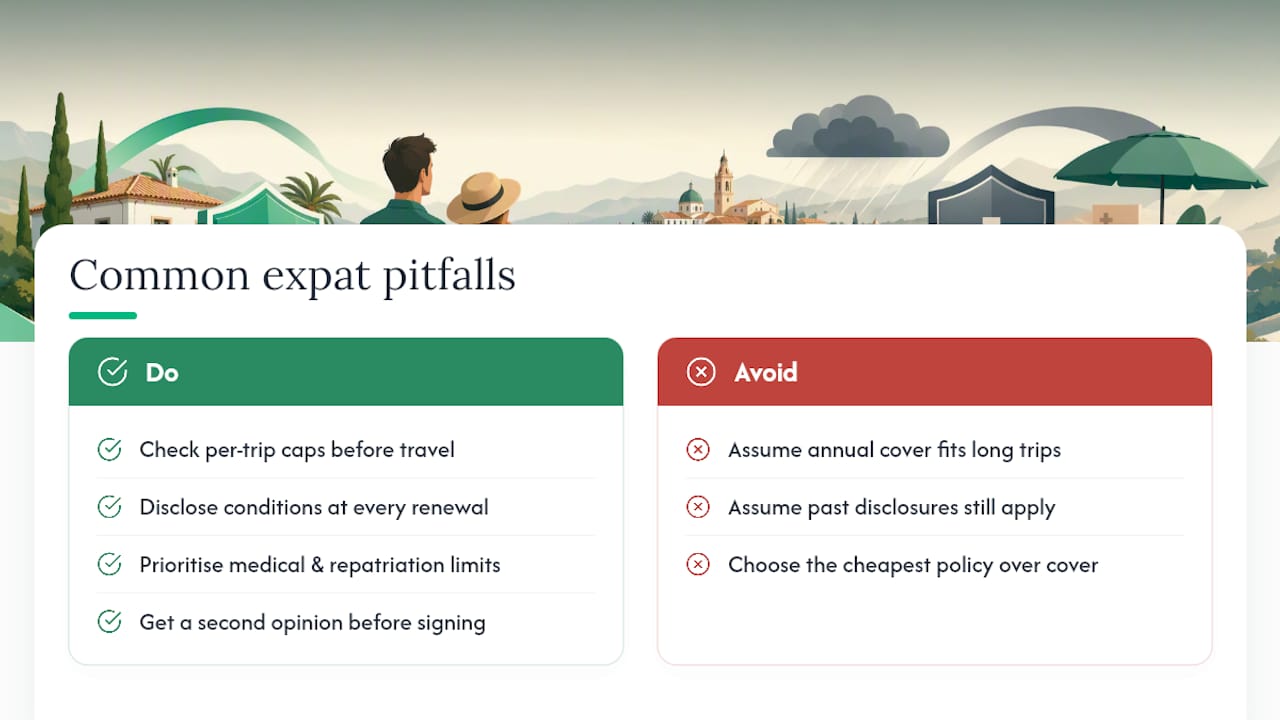
Aucune de ces deux erreurs n'est vraiment une question de négligence. C'est le libellé du contrat qui est rédigé pour les assureurs, pas pour la personne qui souscrit la couverture. Pour toute personne vivant en Espagne, les plafonds médicaux et de rapatriement doivent toujours primer sur le prix ou la commodité dans ces décisions, car une police bon marché à la couverture médicale insuffisante n'est plus une bonne affaire le jour où vous en avez réellement besoin.
Si un point de ce guide reste flou lorsque vous consultez votre propre avis de renouvellement, mieux vaut demander un second avis avant de signer plutôt qu'après avoir déclaré un sinistre.
— Jake
Comparez les polices annuelles et voyage unique avant de vous engager
Passer en revue seul les plafonds de durée de voyage, les plafonds cumulés et les clauses de départ et de retour en Espagne est possible, mais c'est lent, et le libellé diffère d'un assureur à l'autre. Insurance Spain compare les polices voyage de plus de 11 assureurs espagnols de référence, en français, en vérifiant les clauses précises évoquées dans ce guide au regard de votre profil de voyage réel plutôt qu'à partir d'un devis générique.

Cette comparaison couvre les plafonds de durée de voyage, les plafonds cumulés ou par voyage, les zones géographiques et les options comme les sports d'hiver ou la garantie CFAR, afin que vous ne choisissiez pas à l'aveugle entre deux types de police qui se ressemblent sur le papier mais se comportent très différemment au moment d'un sinistre. Si la couverture médicale est votre priorité en tant que résident en Espagne, notre page sur l'assurance santé privée explique comment les plafonds médicaux voyage interagissent avec votre couverture santé habituelle. Pour obtenir une comparaison gratuite et sans engagement des options annuelles et voyage unique adaptée à la fréquence et à la distance de vos voyages, comparez les devis d'assurance voyage dès aujourd'hui avec Insurance Spain.
Sources
- Assurance voyage annuelle ou voyage unique (Comparethemarket)
- Assurance voyage annuelle : comparer les formules et les prix (Squaremouth)
- Assurance voyage unique ou multi-voyages : quand souscrire (NerdWallet)
- Faut-il souscrire une assurance voyage annuelle ou unique ? (MoneySuperMarket)
À lire également
À retenir
- ✓ Trois voyages courts ou plus par an rendent généralement une couverture annuelle multi-voyages moins chère et plus simple ; un long séjour unique ou coûteux est mieux couvert par une police voyage unique.
- ✓ Les polices annuelles plafonnent généralement chaque voyage entre 31 et 70 jours, et dépasser ce plafond peut vous laisser sans couverture pour le voyage concerné.
- ✓ Les plafonds annuels cumulés signifient qu'une indemnisation importante survenue tôt dans l'année peut réduire ce qu'il reste pour les voyages suivants au cours de la même année d'assurance.
- ✓ Vérifiez la zone géographique que vous avez sélectionnée, car les formules Europe uniquement, monde entier hors États-Unis, et monde entier complet, modifient sensiblement le prix et l'éligibilité.
Questions fréquentes
Quick answers on insurance in spain
Encore des questions ?
Contactez-nous0 Comments
Soyez le premier à laisser un commentaire.

