
Whether Spain treats your vehicle as commercial (N1) or personal (M1) determines your registration tax, your VAT and IRPF deductions, and the insurance policy you legally need. Most vans registered for mixed use fall under a 50% business-use presumption unless you can prove otherwise. Get the classification wrong and you risk a rejected claim or a tax inspection you didn’t see coming.
TL;DR:
- Most mixed-use vehicles are presumed to be 50% business use for VAT deduction unless you can demonstrate higher professional activity with detailed logs.
- Registering a vehicle as commercial or personal affects taxes, insurance, and access options, making accurate classification crucial to avoid claims disputes.
- Commercial policies generally include coverage for goods in transit, employer liability, and higher liability limits, which differ significantly from private car policies.
- Misrepresenting your vehicle’s declared use during insurance quoting or tax reporting can lead to rejected claims or increased benefit-in-kind taxes if employees have access to the vehicle.
- Keeping contemporaneous records of vehicle use, mileage, and purpose significantly improves your chances of benefiting from deduction rules and resolving disputes favorably.
Every vehicle permit in Spain carries a category code, and that code drives almost everything downstream: tax, insurance, even which lane you can use at some checkpoints. Two categories matter most for everyday owners.
M1 covers passenger cars: vehicles designed primarily to carry people, with no more than eight seats besides the driver’s. A standard saloon, hatchback or SUV bought for family use sits here.
N1 covers light commercial vehicles, typically vans and pickups under 3.5 tonnes of maximum authorised mass (MMA), built or adapted primarily to carry goods.
Between the two sits the vehículo mixto (multipurpose vehicle), a van fitted with rear seats and windows that can legally carry both cargo and passengers. Spain records this classification on the permiso de circulación itself, in the vehicle category field, and it’s this code, not what the vehicle looks like on the forecourt, that insurers and the Agencia Tributaria will check first.
Registering a vehicle in Spain, whether it arrives from abroad or comes straight from a dealership, follows a set procedure, and if you need assistance with transporting vehicles from abroad, specialized logistics support is available. If you’re bringing a vehicle from another EU country, the official steps for registering an EU vehicle in Spain require the ITV inspection card, proof of tax payment, and a definitive registration application through the Dirección General de Tráfico (DGT).
Commercial vehicles and personal cars follow the same broad process, but the paperwork proving intended use, contracts, business registration, fleet documentation, often shapes which duties and exemptions apply.
A private motor policy and a commercial vehicle policy in Spain aren’t interchangeable, even when they’re covering the same van. Insurers price and structure them differently because the risk profile is different.
Insurers ask about declared use and registration class at quote stage for a reason: if you tell them the van is for personal errands and it’s actually doing daily deliveries, that mismatch can surface exactly when you need the policy most, at claim time. A landscaper running weekly client visits in a van insured for private use may find the insurer disputes a claim on exactly those grounds.
Pro Tip: Write down your actual weekly use pattern before you call an insurer. “Mostly personal, occasional deliveries” gets you a very different quote and a very different level of protection than “daily client visits, tools on board”.
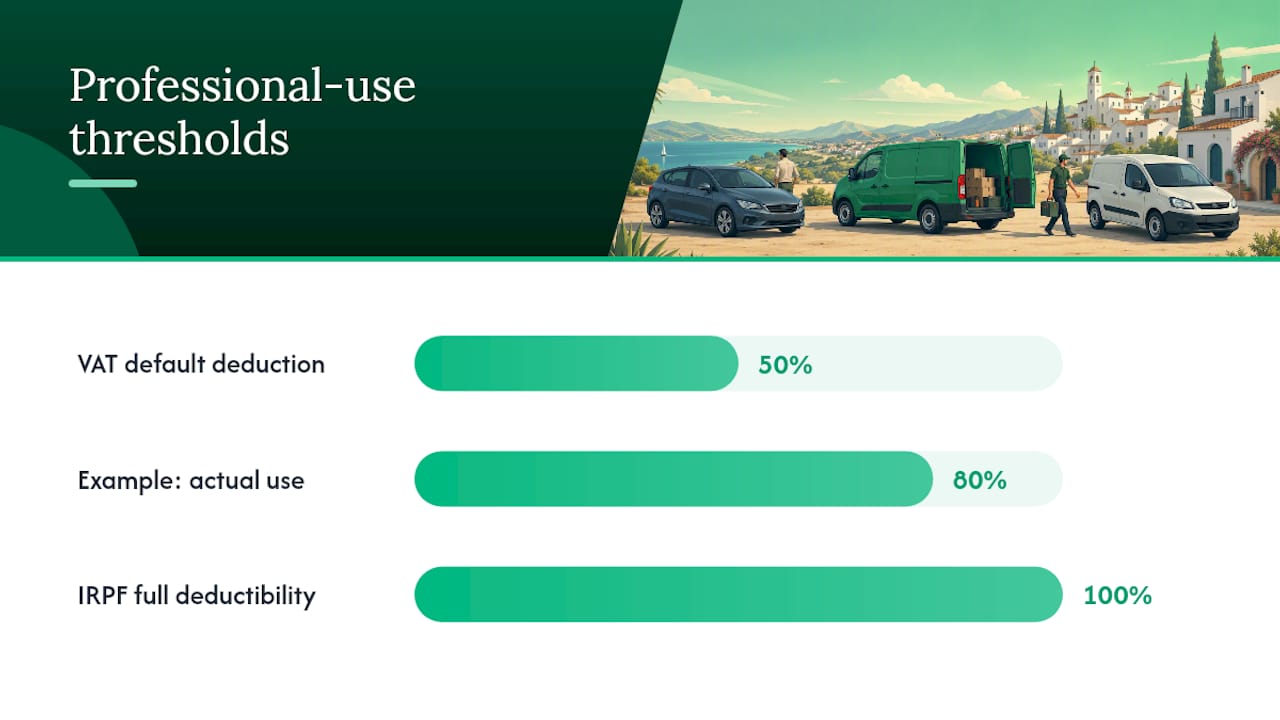
The Agencia Tributaria applies a default 50% presumption for VAT deduction on most mixed-use vehicles. That means, without further evidence, you can deduct half the VAT on purchase, leasing and running costs, even if you genuinely use the vehicle for work most of the time.
The 50/50 default: Half the VAT is deductible automatically. Deducting more requires you to actively prove it.
To claim above 50%, you need documented evidence of predominantly professional use, kilometre logs, client visit sheets, delivery schedules, dated and ideally signed. TEAC doctrine and administrative rulings consistently side against taxpayers who can’t produce this kind of contemporaneous record, though certain categories, vehicles built for goods transport, or used by commercial agents, may carry a 100% professional-use presumption instead.
IRPF treats things more strictly still. Full deductibility of vehicle expenses under personal income tax generally requires exclusive professional use, not “mostly”. Mixed use, even 80% work and 20% personal, tends to cap what you can legitimately deduct.
A vehículo mixto gives owners flexibility: one vehicle, business and private duty. That flexibility has a cost. Spain’s benefit-in-kind rules don’t ask whether an employee actually used the company car at the weekend, they ask whether the car was available to them. Availability alone triggers the tax charge, valued in many scenarios at a standard 20% of the vehicle’s value annually.
Employers who want to limit this exposure need to document restricted private access explicitly, keys returned outside work hours, parking at business premises, written policy on personal use. Employees who can show genuine restrictions have a real basis to challenge an inflated valuation. Nobody wins by leaving the arrangement verbal.
Before you register, insure, or reclassify a vehicle, work through this:
Pro Tip: Ask your insurer and tax adviser the same question in the same week: “Based on this use pattern, which class fits best?” Getting two answers from two professionals before you commit saves a reclassification headache later. If either professional flags a mismatch between your registration and your real use, that’s the moment to talk to DGT or the Agencia Tributaria before, not after, a claim or an inspection forces the issue.
A bilingual insurance brokerage works daily with residents and expats untangling exactly this classification problem, in English, without the jargon. That typically means comparing quotes across Spanish insurers for commercial vehicle cover, helping gather the right documentation, ITV certificates, proof of business use, registration papers, and making sure the declared use on the policy actually matches how the vehicle is driven.
Getting the declaration right at the outset matters more than most people realise: insurers routinely ask for supporting evidence at claim time, and a policy that doesn’t match reality can mean a disputed payout. Before contacting a broker, have your registration document, ITV card, intended use, and rough annual mileage ready. It shortens the conversation considerably.
Spain’s system rewards documentation and punishes ambiguity. That’s the pattern running through registration, VAT, IRPF and insurance alike: the vehicle itself matters less than what you can prove about how it’s used.
The conventional advice, “just register it as commercial if you use it for work sometimes,” misses the point entirely. Partial business use without records gets you the 50% VAT default and a benefit-in-kind exposure if an employee is involved, not the full deduction owners assume they’re entitled to. The vehicle’s category on paper is only the starting position; the paperwork behind it is what a tax inspector or claims handler actually tests.
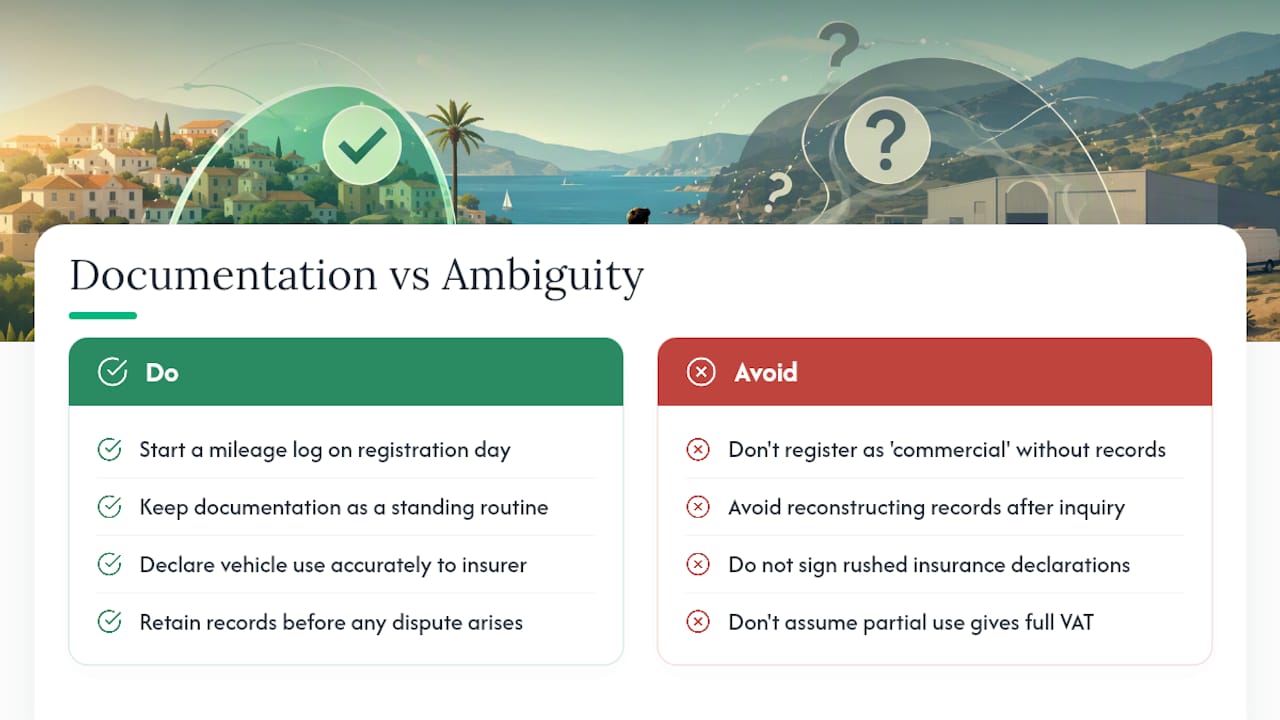
What should change first, for most readers, is habit rather than paperwork. Start a mileage log the day you register the vehicle, not the day the Agencia Tributaria asks for one. Owners who treat documentation as a standing routine consistently fare better in disputes than those who reconstruct it retrospectively, and TEAC rulings bear that out repeatedly. The classification decision matters, but it’s the weakest link in most disputes we see, not the strongest.
If there’s one place where expats get caught out disproportionately, it’s insurance declarations made in a rush, often in a second language, without fully grasping what “declared use” commits them to. That’s a solvable problem, and it’s worth solving before the policy is signed, not after a claim is refused.
— Jake
Whether your vehicle sits as M1, N1 or vehículo mixto, the insurance policy behind it needs to match reality, not just the registration document. A bilingual broker compares cover across multiple leading Spanish insurers, so you get a policy that actually fits your declared use, not a generic private or commercial default that leaves gaps.

Contact Insurancespain before you register a change of use, import a vehicle, or renew an existing policy, timing genuinely matters here, since a mismatched declaration is far easier to fix before a claim than during one. Have your registration document, ITV card, and expected annual mileage to hand, and the comparison across insurers moves quickly. Start with a free quote comparison for commercial or mixed-use vehicle cover, or explore the full range of coverage options if you’re insuring a home, health plan, or UK-registered car alongside your vehicle.
This article is general information, not a substitute for advice from a qualified lawyer. Consult a qualified legal professional about your own circumstances before acting on anything here.
A commercial vehicle (N1) is built primarily to carry goods and is registered, taxed and insured under different rules to a private car (M1), which is designed mainly to carry people.
Vans, pickups and light trucks up to 3.5 tonnes MMA built or adapted mainly for carrying goods fall under N1 classification, while a vehículo mixto sits between commercial and personal use depending on its fit-out and declared purpose.
Certain vehicles qualify for IEDMT exemption, most commonly when the registration follows a genuine transfer of habitual residence to Spain, provided the DGT’s documentary requirements are met.
No confirmed nationwide overhaul of commercial versus personal vehicle classification has been announced; the safest approach is to check current DGT and Agencia Tributaria guidance directly before assuming any rule has changed.
Yes, in most cases. Insurers price commercial and private use differently, and Insurancespain can compare commercial vehicle insurance options to match a policy to your actual use pattern rather than a default assumption.
Bli den første til å kommentere.
